Featured

How DIGITAL Has Become a Key Driver of the Indian ECONOMY

Source: https://www.istockphoto.com/photos/digital-economy-india

India has emerged as a shining star on the global economic horizon as the world recovers from the aftermath of the pandemic. India was the world’s fastest growing major economy in 2021 and 2022 and will continue to be so during the current and the next few years as well. During FY23, the Indian economy is projected to grow by 7.0%, while the latest forecast by The World Bank for FY24 is 6.6%. In contrast, the global economy is expected to grow by just 1.7% during 2023. India would be thus, for the first time in many decades, driving the global economy, even as most of the major economies are witnessing a significant slowdown in economic growth.

One of the key factors that is driving this economic transformation in India is its rapidly growing digital economy. Digital economy has prospered greatly under the Digital India programme and is expected to reach $1 trillion by FY27 from its current level of about $300 billion, thus increasing its share in the GDP from around 9% currently to about 20% during this period. Digital economy would thus be a key driver for our overall economic growth in the coming years.

How has the Digital Economy Become so Vital to the Country’s Broader Economy?

Across the board digitalisation in both public and private sectors is helping in generating innovation and unlocking major efficiency and productivity gains. The government has created several major cross-cutting national public digital platforms, such as Aadhar for digital identity, Unified Payments Interface (UPI) for online payments, Government e-Marketplace (GeM) for public procurement, Goods and Services Tax Network (GSTN) for indirect taxation, GatiShakti for logistics, etc. that have completely transformed the way government agencies deliver services and how businesses operate.

These platforms have enabled the government to make all citizen and business centric services fully online, and businesses to digitalize their operations and realize payments and tax refunds without delay. Fully online Account Aggregators are now making credit available to individuals and MSMEs easily without any paperwork through consent-based online data sharing.  These are bringing major improvements in the flow of credit and efficient utilisation of resources across the entire economy.

Massive digitalisation by the government in almost all domains of governance has also helped in improving both ease of doing business and ease of living for citizens. Most of the government agencies, at the central, state and local levels, have undertaken significant process re-engineering for digitalising their services and this has helped in making the entire approval process and delivery of services time-bound and predictable. This has been achieved despite the fact that most of the laws governing these domains have remained the same. 

What is Driving this Digital Transformation in India?

India has a young population with around 840 million internet users and a rapidly growing smartphone penetration even amongst the rural population. Availability of high-speed 4G network and the world’s cheapest data rates are bringing more and more people online. The adoption of digital technologies has also increased manifold during the pandemic, both for personal and professional activities. The increasing optic fibre penetration in villages under BharatNet and the quickly expanding 5G network would help in bringing the last 40% of our population online in the near future.  

Massive digitalisation in the economy has also helped our start-ups in creating businesses based on innovation and becoming competitive internationally. Today, a vast majority of nearly 80,000 startups are tech-focused with a combined valuation of around $450 billion. With over 100 unicorns, the Indian startup ecosystem is the third largest in the world.

With the advent of emerging technologies such as artificial intelligence, blockchain, augmented and virtual reality, Internet of Things, metaverse, Industry 4.0, etc., the contribution of digital economy to India’s economic growth is expected to gain further momentum in future. However, these are also expected to bring new challenges, especially in addressing online user harms, cybersecurity and protection of personal data and privacy.

To enable the digital economy to drive the next phase of growth in the broader economy, India would need to focus on creating a world-class digital infrastructure including new age data centres, become a global hub for electronics and semiconductor manufacturing, create world-leading public digital platforms in domains like healthcare, agriculture, education, logistics, etc., ensure cybersecurity, drive innovation through the emerging technologies, bring new legal and regulatory framework to deal with data sharing and personal data protection and focus massively on skilling. Achieving this vision for the next phase of Digital India will also make India the global leader in digital economy within this decade.  

The above article appeared in The Economic Times on 12th February, 2023 and is available here: https://economictimes.indiatimes.com/tech/catalysts/ettech-opinion-digital-a-key-driver-of-the-indian-economy/articleshow/97825464.cms?from=mdr. The views expressed are personal.

Featured

How Bharat is being digitally transformed

Digital India is a flagship programme of the government that aims at transforming India into a digitally empowered economy and knowledge society. It was approved in August 2014 with three key goals in mind: provide quality digital infrastructure to every citizen, provide all public services digitally on demand and empower citizens digitally to enable them to participate fully in a rapidly digitalising economy and society. The approach was to involve all the central ministries and all the states in a whole-of-government framework to work holistically to achieve these goals. How has the programme performed in its eight years of implementation and what lies ahead for it?  

The achievements under the programme have been quite impressive by any standards. BharatNet has become the world’s largest rural broadband programme with over 5.75 lakh kilometers of optical fibre laid to connect over 1.85 lakh village panchayats. With near universal 4G coverage, the number of internet users in India has exploded to 83 crores with access to the world’s cheapest mobile data. A huge network of nearly 5 lakh common services centres across the entire country provide assisted access to a wide range of online services. The coverage of Aadhaar and banking services have become near universal, allowing everyone to access online services and receive benefits in their bank accounts directly. Digital inclusion has been a key goal of this programme with over 5.14 crore people trained in digital literacy under the Prime Minister’s Gramin Digital Saksharta Abhiyan.  

The confluence of universal digital identity, banking services, mobile phones and increasing digital literacy has resulted in huge expansion of demand for online services. The volume of online transactions has grown over 50 times to over 34 crores per day. DigiLocker, Mobile Seva and UMANG platforms have greatly simplified the access to a wide range of public services through mobiles. Digital life certificates through Jeevan Praman have proved to be a boon to over 5.6 crore pensioners in the country.    

India is now the global leader in digital payments with the Unified Payments Interface transactions crossing the $1 trillion mark in value during 2021-22. The Direct Benefits Transfer now covers over 300 schemes and over 22.7 lakh crore have already been transferred to the beneficiaries’ bank accounts directly.

New-age digital platforms in health and education have transformed the delivery of services in these domains. CoWin has become the world-leading platform for covid vaccinations with over 194 crore vaccine doses administered. The online teleconsultation platform, e-Sanjeevani, has greatly helped the people in accessing healthcare services during covid with nearly 4 crore tele-consultations conducted. Under the Ayushman Bharat Digital Mission, over 22 crore health accounts have been created. Similarly, DIKSHA is the nation’s largest online platform for school education.

With a thriving technology and innovation ecosystem, India has become the world’s third largest startup hub with over 100 unicorns. Tech startups alone have created over 23 lakh jobs since 2016. Many of these startups are focused on advanced research and development in emerging technologies, such as artificial intelligence, blockchain, metaverse, web 3.0, robotics, Internet of Things, 5G, etc.

India has also made great strides in electronics manufacturing with the country now the world’s second largest manufacturer of mobile phones in terms of volume. With the new Production-Linked Incentives schemes, the country is poised to become a global leader in semiconductors and large-scale electronics manufacturing as well.

With such impressive achievements under its belt, what lies next for Digital India? It is clear that the programme owes its success to well-defined goals, adequate funding and a whole-of-government approach in both conceptualisation and implementation of various schemes. It must now transform itself in both scale and scope to achieve the target of $1 trillion digital economy by 2026 and make India a global leader in advanced digital technologies. Scaling up would involve enhancing the coverage of the programme to the entire country including all the villages and the entire population including women and the weaker sections. On the other hand, enhancing the scope would imply that such digital transformation permeates all sectors of the economy including the micro, small and medium enterprises and all governance domains, both at the central and state levels. For achieving this vision, specific focus would be required in the next phase of the programme on digital infrastructure, digital government, electronics manufacturing, modern digital laws with a focus on digital privacy, cyber security, capacity building and skilling.

(The above article appeared in The Economic Times on July 3, 2022 and is available at https://economictimes.indiatimes.com/tech/technology/how-bharat-is-being-digitally-transformed/articleshow/92613053.cms?from=mdr. The views expressed in the article are personal.)

Featured

Digital India: What’s Next?

Source: http://www.pexels.com

Digital transformation is a key central theme of Budget 2022 with announcements ranging from infrastructure status to data centres to taking fibre to all panchayats under the BharatNet programme. Introduction of a blockchain based sovereign digital currency, setting up of 75 digital banking units, constitution of an Animation, Visual effects, Gaming and Comics (AVGC) task force, launch of a digital university, digitalisation of school education platforms and support for the Production Linked Incentive (PLI) scheme for large scale electronics manufacturing and IT hardware were also part of the overall focus. The incentive scheme of US $10 billion for semiconductor and display fabs announced earlier also fits into the broader vision for making India “Aatmanirbhar” and a global leader in digital technologies.

How can the Digital India programme be reinvented to achieve this vision? This programme, launched in 2015 with the goal of ushering in digitally driven transformation in governance, economy and society, already has many highly noteworthy achievements. Many flagship schemes, e.g., the Unified Payments Interface (UPI), the digital literacy programme (PMGDISHA), e-Hospital, DigiLocker, Common Service Centres (CSCs), etc. have seen massive expansion under Digital India. The number of internet users has also grown to over 83 crores now, which is fuelling further aspirations for a full-scale digital transformation in all domains with focus on ease of living and ease of doing business.

The Digital India 2.0 needs to be architected on six major pillars for accelerating digitalisation and achieving the vision of complete digital transformation. First, it needs to ensure provision of world-class digital infrastructure in the country, including high-speed broadband connectivity to all through fibre and 5G network, and hyperscale data centres to make India a global hub for data centres and cloud. With increasing focus on privacy, security and the need for storing data within the country, there are strong demand drivers in place for making investments in data centres attractive.

Second, digital government and digital services need to undergo a paradigm shift with focus on data governance, whole-of-government approach and creation of new public digital platforms in major domains such as education, health, agriculture, logistics, etc. The National Digital Health Mission and the PM Gati Shakti initiatives are aimed at this vision. There is a need for building similar public digital platforms in other domains. There also needs to be a strong focus on standards, interoperability and using common technology platforms, such as Aadhaar, UPI, Single Sign-on, etc. to make the development of new applications easier and faster.

The third major area where there is a great potential for digital transformation is in accelerating the growth of our digital economy to at least USD one trillion in the next 4-5 years. This requires ensuring high and sustainable growth in electronics manufacturing, IT-ITES and emerging technologies, such as artificial intelligence, machine learning, Internet of Things, 5G, etc. Creating a vibrant start-up ecosystem in these areas holds the key to achieving the trillion-dollar digital economy goal.   

Fourth, we need to modernise our digital laws to support the rapid growth of the digital economy, and address the growing concerns on accountability of online platforms and increasing cyber security threats. Enacting the personal data protection bill would help in addressing the privacy concerns. The new statutes would be helpful in creating trust and confidence amongst the users in the online world, which is crucial for digital inclusion as we need to focus now on bringing the remaining 40% of the population into the digital world.

Another major area of focus should be on rapid advancements in strategic and emerging technologies with ownership of intellectual property. We need to quickly formulate national strategies in these areas and fund the flagship initiatives. Recently published strategies by MeitY on blockchain and additive manufacturing are steps in the right direction. A national policy on data governance also needs to be formulated so that access to data, so crucial to advancement in these technologies, is made easier for our researchers, start-ups, etc.

Last, but not the least, there needs to be a strong push for skilling and capacity building in digital technologies at all levels in partnership with the industry and academia. Schemes such as FutureSkills Prime need to be expanded to provide for the rapidly growing need for highly skilled resources. PMGDISHA needs to expand at the population scale to make all citizens digitally literate. India should rightly aim at becoming the skill and talent capital of the world.

With rapid strides already made under the Digital India programme, it is the right time to visualise India becoming a global leader in digital technologies across the entire spectrum, not just in IT services. The next phase of Digital India should aim to achieve this vision.

(The above article appeared in The Economic Times on April 3, 2022 and is available at: https://economictimes.indiatimes.com/tech/technology/whats-next-for-digital-india/articleshow/90608332.cms. The views are personal.)

Featured

A Holistic Approach to Personal Data Protection

Source: https://www.pexels.com/

After detailed deliberations, the Joint Committee of Parliament on the Personal Data Protection Bill has made several important recommendations, and a debate is currently raging in the country over some of those proposals.

The Committee’s recommendations need to be understood in the broader context of personal data protection and to support the growth of a robust innovation and data-driven digital economy.

The Committee has proposed to include a new clause to include non-personal data within the ambit of the Bill, since renamed as Data Protection Bill, 2021.

This has been done to take a holistic approach towards processing of data, both personal and non-personal, as with the advent of advanced technologies like artificial intelligence and sophisticated data analytics, it may not be too difficult in future to relate anonymised personal data (a form of non-personal data) to individuals.

However, the revised Bill only contains a provision for formulating rules regarding non-personal data at a later stage. Currently, it does not have any substantive provisions in this regard.

A key provision in the Bill to allow certain exemptions to the government data fiduciaries has generated a lot of discussion.

The exemptions under Section 35 of the Bill need to be on a case-to-case basis and only on the grounds of sovereignty and integrity of India, security, etc. which are within the ambit of reasonable restrictions under Article 19(2) of the Constitution.

Further, the reasons for exemptions have to be just, fair, reasonable and proportionate which are as per norms laid down by the Supreme Court in its 2017 privacy judgement in the Puttaswamy case.  

The exemptions under Section 12 are narrower and more specific for facilitating better delivery of government services, disaster management, dealing with epidemics and medical emergencies, etc.

Government entities are not exempted from their obligations as data fiduciaries and complying with the rights of data principals in general. There are adequate safeguards in the Bill to prevent any misuse of such exemptions, including oversight by the Data Protection Authority (DPA).    

Another recommendation that has generated much debate relates to making social media platforms liable for content hosted on their platforms from unverified accounts and making verification of accounts mandatory.  

However, this is only for those platforms that do not act as intermediaries eligible for safe harbour as per Section 79 of the Information Technology Act, 2000. This is only a recommendation that needs to be examined by the government later and is not part of the revised Bill.  

Concerns have also been raised over the compliance burden on startups and its impact on innovation.

To address this concern, the Bill places much greater emphasis on compliance by the significant data fiduciaries with additional obligations, such as periodic audits, appointment of data protection officers, etc. Startups and small businesses do not need to comply with these additional obligations as they would not be classified as significant data fiduciaries.

The Bill also provides for the creation of a sandbox to encourage innovation. Processing of personal data of foreign nationals is also exempted under the Bill.

Another key concern is regarding the provisions for data localisation.

Section 33 of the Bill makes it clear that sensitive personal data shall continue to be stored in India, while Section 34 allows its transfer outside India under certain conditions.

The EU GDPR places similar conditions on data transfer to only those countries which fulfil the ‘data adequacy’ norms.

These provisions will make it easier for Indian entities to attract more outsourcing business from abroad as India would fulfil these norms. Storage of sensitive personal data within India would support the growth of hyperscale data centres and an innovative data-driven economy.

Concerns have also been raised over another recommendation relating to norms for testing the integrity of hardware and software on devices.

This has been done to prevent any unauthorised data breaches through insertion of any untrusted hardware. This provision has been added within the scope of functions of the DPA under Section 49 and can be implemented only after the DPA formulates an appropriate code of practice in consultation with the relevant stakeholders.   

The concept of privacy has evolved from the Aristotelian concept of idios, meaning “one’s own” or “private”, in ancient times to its modern-day focus on informational privacy.

The Data Protection Bill, 2021 provides a holistic framework for addressing informational privacy that will also help greatly in the growth of a robust digital economy in India.

(The above article appeared in The Economic Times on January 9, 2022 and is available at: https://economictimes.indiatimes.com/tech/catalysts/ettech-opinion-a-holistic-approach-to-personal-data-protection/articleshow/88775228.cms?from=mdr. The views are personal.)

Featured

Traceability vs Privacy: The Real Issue is of Collective Security

Source: weforum.org

Societies have long realised the need to provide collective security for all to ensure sustainable development and prosperity. Providing collective security involved imposing some form of social control to regulate individual and group behaviour through gathering information about individuals. In the modern information age, a good government can ensure collective security through efficient use of information for law enforcement without necessarily encroaching upon individual privacy.  

Countries around the world have enacted laws to ensure that such information could be collected easily through various sources to help in achieving the wider societal goal of collective security. The US enacted the Stored Communications Act (SCA) in 1986 to require the internet service providers (ISPs) to provide content and metadata on stored emails to the government agencies under certain conditions. As this law soon became outdated due to rapid technological advances, the US passed the Communication Assistance for Law Enforcement Act (CALEA) that required the telecom companies to redesign their networks to facilitate wiretapping by the government agencies. Later, in 2005, it was expanded to cover ISPs and services like Skype, etc.   

UK and Australia have gone even further in enacting laws that require device makers and software developers to provide access to encrypted data. The Investigative Powers Act 2016 and the Investigatory Powers Regulations 2018 in the UK provide sweeping powers to the intelligence and law enforcement agencies to carry out both targeted and bulk interception of internet communications and hack into devices to access data. The Telecommunications Assistance and Access Act 2018 of Australia gives broad powers to the government agencies to require communication service providers (CSPs) to decrypt any communication.

The raging debate in India over the ‘traceability’ provision in the Information Technology (Intermediary Guidelines and Digital Media Ethics Code) Rules, 2021 must be understood in the context of the need for ensuring collective security as a social good. The rules require the significant social media intermediaries to identify the first originator of a message in India for investigation of grave offences relating to the sovereignty and integrity of the country, crimes against women and children, etc. that are punishable with a minimum prison term of 5 years.

Critics have claimed that this provision would seriously undermine privacy and force the intermediaries to break the end-to-end encryption. However, the rules make it very clear that what is required to be provided by the intermediaries is only the metadata about the first originator of the offending message, and not its contents.  The message itself needs to be provided by the law enforcement agencies to the intermediaries. There is no attempt to make them break any encryption. With such safeguards built into the rules, the provision cannot be termed as harming privacy. In fact, the rules place much less onerous obligations on the intermediaries for sharing information compared to what several other countries have mandated, as noted earlier.

The law and the evolving jurisprudence in this domain in India have provided strong safeguards for ensuring freedom of expression and privacy. The upcoming Personal Data Protection Bill aims to further enhance this legal framework for protection of personal data and online privacy subject to reasonable checks in the interest of collective and national security. John Locke, a famous 17th century philosopher and the “Father of Liberalism”, argued in his Second Treatise of Civil Government that individuals needed a strong government to be able to exercise their individual rights and liberties.  

There need not necessarily be a trade-off between privacy and collective security. Collective security is just as essential to make people feel safe and allow them to enjoy their privacy protections to function effectively as individuals.  The new IT Rules seek to achieve that larger social good.

(The above article appeared in The Economic Times on 10th October 2021. It is available at: https://economictimes.indiatimes.com/tech/catalysts/traceability-vs-privacy-the-real-issue-is-of-collective-security/articleshow/86721078.cms?from=mdr. The views are personal.)

Featured

The Race for Global Leadership in AI: Where Does India Stand?

Photo by Tara Winstead on Pexels.com

Over 50 countries around the world have announced their own national strategies on Artificial Intelligence (AI) and many others are rushing to do so. AI holds great potential as the key driving force for the next phase of economic growth led by technological innovation and no nation wants to be left behind. However, which countries are early movers in the global AI sweepstakes and where does India stand in the race for global AI leadership?

AI generally refers to capability of machines to mimic human-like cognitive functions, such as learning, thinking and problem solving. It comprises a suite of technologies, e.g., machine learning, deep learning, speech recognition, image processing, etc. that underpin broader technologically driven transformations happening in diverse domains: education, healthcare, industry 4.0, autonomous vehicles, etc. AI also has huge potential military applications in the development of autonomous weapons. There is a growing feeling in many countries that leadership in AI would be crucial in determining strategic and geopolitical influence in future, both at regional and global levels.

Several countries and jurisdictions, such as USA, China, European Union, UK, etc., have already announced their national AI strategies and are early movers in this rapidly evolving technology. Most of them have tried to leverage their own strengths to advance their capabilities in AI. However, they all focus on certain common key elements in varying degrees in their strategies: research and development (R&D), skilling, building data ecosystems, developing computing and network infrastructure, collaborative partnerships, ethics, and regulation.

The US launched its first federal initiative on AI in 2016 and a revamped initiative in 2019 with focus on five key elements: R&D, technical standards, training, promoting public trust and confidence, and protecting the American technological advantage while promoting international collaboration. It has generously funded its AI initiative, with a total budget of approximately $1 billion for non-defence AI R&D in 2020. It had also committed $2 billion over five years on AI R&D in defence in 2018.

The European Union (EU) first published its Coordinated Plan on AI in 2018. It has published an updated plan in April 2021 that focuses on four key components: AI development and implementation, R&D and building data ecosystems, skilling and fostering trust in AI, and building strategic leadership in high impact sectors such as climate, health, and mobility. The public and private funding for AI is estimated to be around EUR 20 billion per year till 2030.

China announced its “New Generation Artificial Intelligence Development Plan” in 2017 with the overarching goal of becoming the world leader in AI by 2030 by creating a trillion Yuan (approx. US$ 150 billion) AI industry in China. The plan focuses on developing and deploying AI in a wide range of economic sectors including defence. While the plan and the strategy are central, the implementation is to be done by the local governments and the private sector. The total national and local government funding on AI programmes is estimated to be in the range of tens of billions of US dollars.

The UK announced its AI Sector Deal in 2018 with the key goal of becoming the world’s most innovative economy in AI. It focuses on education and training, R&D, promoting networking and partnerships, regulation to build trust, developing open data ecosystems, and networking and computing infrastructure. The total funding commitment for the strategy is around GBP 2.7 billion.

Where does India stand in the global race for leadership in AI? The NITI Aayog’s discussion paper on national strategy on AI in 2018 focuses on leveraging AI for inclusive growth and mentions five key domains: healthcare, education, agriculture, smart cities, and transportation and mobility. It also notes five key barriers to excellence in AI that need to be addressed: lack of R&D expertise, lack of high-quality datasets, lack of a regulatory framework on privacy and security, high resource cost and low awareness, and absence of a collaborative approach to adoption and applications. It proposed setting up of five centres of research excellence and 20 centres for transformational AI with a total funding of around Rs. 7,000 crores. However, though the strategy paper was published in 2018, India is yet to launch a comprehensive and coordinated national programme on AI. One study by Oxford Insights placed India at the 40th position in the world in the Government AI Readiness Index out of 172 countries, a drop of 23 places from the 2019 rankings. Though India currently ranks third in the world in terms of total number of research publications in AI, we need to quickly formulate and implement a well-designed national programme on AI with adequate funding to become a global leader in this strategic technology. This is eminently possible if we can leverage our strengths in R&D due to a strong network of academic and research institutions, availability of a huge talent base and high-quality datasets in diverse domains, and presence of a globally competitive IT sector within the country.

(The author is a senior IAS officer and is currently working as Additional Secretary in the Ministry of Electronics and IT. The views are personal.)

The above article appeared in The Economic Times on 22 August, 2021. The link is here: https://economictimes.indiatimes.com/tech/tech-bytes/the-race-for-global-leadership-in-ai-where-does-india-stand/articleshow/85520265.cms

Featured

Unduly Worried Over New Information Technology Rules

Photo by Canva Studio on Pexels.com

In a communication dated June 11, three UN Special Rapporteurs raised serious concerns over provisions of the Information Technology (Intermediary Guidelines and Digital Media Ethics Code) Rules, 2021. They claim that these provisions do not meet the standards of rights to privacy and to freedom of expression as per the Articles 17 and 19 of the International Covenant on Civil and Political Rights (ICCPR) and that some of the due diligence obligations of intermediaries may infringe upon a ‘’wide range of human rights”.

They claim that the terms such as “ethnically or racially objectionable”, “harmful to child”, “impersonates another person”, etc. are broad and lack clear definitions and may lead to arbitrary application. Nothing could be further from truth. These terms have been very well defined and understood in both Indian and international law and jurisprudence. The Rule 3(1)(b) of the IT Rules specifies these terms clearly as part of a user agreement that the intermediaries must publish. They are aimed at bringing more transparency in how intermediaries deal with the user content and are not violative of the UN’s Joint Declaration on Freedom of Expression and “Fake News”, Disinformation and Propaganda.

It must also be mentioned that the Rule 3(1)(d) allows for removal of an unlawful content relating to sovereignty and integrity of India, security of the state, friendly relations with foreign states, public order, etc. only upon an order by a competent court or by the Appropriate Government. This is as per the due process specified by the Supreme Court in the Shreya Singhal Vs Union of India case in 2015. Given the potential of immense harm that can be caused by such unlawful content being freely available online, the time limit of 36 hours for their removal after due process is reasonable. Similarly, the time limit of 72 hours for providing information for investigation in response to lawful requests in writing from government agencies is entirely reasonable. The Rule 3(2) also provides for establishing a grievance redressal mechanism by the intermediaries and resolution of user complaints within 15 days. However, content in the nature of ‘revenge porn’ must be removed within 24 hours. Again, given the potential of immense personal damage that such acts can cause to the dignity of women and children, this time limit is reasonable.  

The liability of the Chief Compliance Officer under Rule 4(1) of a significant social media intermediary is not arbitrary. He or she can be held liable in any proceeding only after a due process of law. This has been clearly specified in the rule itself.

The apprehensions about the Rules harming privacy are also misplaced. The Rule 4(2) requires the significant social media intermediaries to provide only the metadata about the first originator of a viral message that may be required for investigation of a serious crime relating to sovereignty and integrity of India, public order, rape, child sexual abuse, etc. that are punishable with a minimum term of five years. This again is after a lawful order is passed by a court or a competent authority and where there is no other less intrusive means of obtaining such information. There is no provision to ask the intermediary to break any encryption to obtain the contents of the message. In fact, the content is provided by the law enforcement agencies to the intermediary. Lawful investigation of crimes cannot be termed as harmful to privacy. Several countries, such as the US, UK and Australia have enacted laws that allow for far more intrusive interception of encrypted messages, including their decryption.

The concerns with regard to media freedom are also misplaced. The section 5 of the UN’s Joint Declaration on Freedom of Expression and “Fake News”, specifically enjoins upon the media outlets to provide for self-regulation at the individual media outlet level and/or at the media sector level. The IT Rules provide for a three-tier system of regulation, in which the government oversight mechanism comes in at the third level only after the first two tiers of self-regulation have failed to produce a resolution. The rules clearly specify the due process for the government oversight mechanism.

India is a vibrant democracy with a long tradition of rule of law and respect for freedom of expression and privacy. The IT Rules aim at empowering the users to enable them to exercise their right to freedom of expression responsibly and prevent the misuse of these platforms for unlawful purposes. The selective interpretation of the provisions of the IT Rules by the UN Rapporteurs is, at best, disingenuous.  

(The above article appeared in The Economic Times on July 11, 2021 and is available at https://economictimes.indiatimes.com/opinion/et-commentary/unduly-worried-over-new-rules/articleshow/84323812.cms?from=mdr. The views expressed by the author are personal.)

Featured

New Code for Digital Media Seeks to Strike a Balance Between Freedom and Responsibility

Photo by Tracy Le Blanc on Pexels.com

Countries around the world have grappled with the issue of regulating content hosted by the internet intermediaries. As the internet allows freedom to anyone to host content without any moderation, intermediaries were allowed protection from liability for third-party content through laws such as section 230 of the Communications Decency Act in the US and the safe harbour provisions in the EU with certain exceptions for illegal content.  

Section 79 of the IT Act in India also allowed exemption to the intermediaries for third-party content provided they observed certain due diligence. The content could be removed only based on orders from a court or from an authorised government agency with certain conditions as laid down by the Supreme Court in the 2015 Shreya Singhal vs Union of India case.

This classical interpretation of the role of intermediaries worked satisfactorily for several years as the services they provided were predominantly passive in nature. However, the enormous growth of social media during the last decade with their hundreds of millions of users has made the limitations of this framework starkly evident as they have been unable to check the proliferation of fake news, and other illegal and harmful content on their platforms. The proliferation of fake accounts and bots has only aggravated the problem. Several countries, e.g., Germany, France, Australia and Singapore have enacted legislation to deal with unlawful and harmful content on these platforms.

The new Intermediary Guidelines and Digital Media Ethics Code must be seen in the context of the need to make these platforms more responsible and accountable. These rules specify certain due diligence and institute a mechanism for redressal of grievances. The due diligence includes informing the users about their privacy policy and an agreement not to host any unlawful or harmful content. The rules envisage removal of content only in three situations: voluntary removal due to violation of the privacy policy or user agreement, pursuant to an order by a court or an authorised government agency or based on the grievances received.

The rules also specify some additional due diligence to be observed by ‘significant social media intermediaries’, defined based on the number of registered users (currently specified as 50 lakhs) in India. These include appointment of a Chief Compliance Officer, a nodal contact person, and a Resident Grievance Officer, who should all be residents in India. The intermediary should also have a physical contact address in India. The rules also include providing information about the first originator in India of any unlawful message for the purposes of investigation of specified offences that are punishable with imprisonment of not less than five years. It must be noted that the intermediary is not required to disclose the contents of the message itself.

The Digital Media Ethics Code under these rules create a largely self-regulatory framework for publishers of online news and current affairs and online curated content on Over-the-Top (OTT) platforms. The oversight mechanism of the government comes into play only after the redressal mechanism at the first two levels has failed to address the grievance satisfactorily.

It is relevant to note that the exemptions to the intermediaries under section 79 are still available, provided they observe the due diligence as specified.

Freedom of expression must come with adequate responsibility and accountability. John Stuart Mill, one of the most influential thinkers in classical liberalism, explicitly recognized the ‘harm principle’ while arguing for placing some limitations on free expression. The new rules seek to strike a fine balance between freedom and responsibility in the online world.

(The above article appeared in The Economic Times on March 19, 2021 and is available at: https://economictimes.indiatimes.com/industry/media/entertainment/media/view-new-code-for-digital-media-seeks-to-strike-a-balance-between-freedom-responsibility/articleshow/81593609.cms. The views of the author are personal.)

Featured

The COVID-19 Pandemic: Are We Still in the Exponential Growth Phase?

Microscopic view of Coronavirus, a pathogen that attacks the respiratory tract (source: https://www.health.harvard.edu/)

The Novel Coronavirus or COVID-19 pandemic is sweeping the world. As on March 31st, 2020 (end of day, GMT), the total cumulative number of confirmed coronavirus cases worldwide had shot up to 858,355 and the total number of deaths had increased cumulatively to 42,309. The total number of new confirmed cases on a single day on March 31st, 2020 alone was recorded at 73,617. What is the trend of daily new cases worldwide and are there any signs of the growth tapering off? In other words, has the exponential growth phase of the pandemic passed or still continuing? What about the trends in deaths due to coronavirus? In this article, I make an attempt to analyze these trends based on the relevant data for a period of 31 days from March 01, 2020 to March 31, 2020.

First, it is helpful to see how the total confirmed coronavirus cases have increased over the last 30 days (Fig.1). As can be seen, the rising trend in the total number of cases can be clearly observed. The daily new cases are also clearly showing a rising trend during this period.

Fig.1: Coronavirus cases – worldwide.

Source: The author, with data from https://www.worldometers.info/coronavirus/ (accessed on April 1, 2020).

To examine whether the growth in the total number of cases is still continuing at an exponential rate, we turn to another important variable – the growth factor of daily new cases. This factor is the ratio of number of daily new cases over the number of new cases on the previous day. Simply put, this factor indicates the rate at which a given quantity multiplies itself during a specific period. For example, a growth factor of 1.1 in daily new cases would indicate that the number of daily new cases has increased by 10% (by a growth factor of 1.1) over the number of new cases on the previous day. If the growth factor remains consistently above 1.0, that would indicate that the exponential growth phase in total cases is still continuing. On the other hand, a growth factor consistently below 1.0 would indicate a decline in daily new cases with the daily new cases eventually becoming zero. In such a scenario, the cumulative total number of cases would eventually stop growing.

Fig. 2 indicates the trend in growth factor of daily new coronavirus cases worldwide. As can be seen, during March 2020, only on 7 days (out of 31), the daily growth factor has remained below 1.0. On 24 days, the growth factor has stayed above 1.0. In the last ten days of this period, the daily growth factor has remained above 1.0 on eight days. This would indicate that the exponential growth in the total number of cases worldwide may still be continuing. 

Fig.2: Growth Factor of Daily New Coronavirus Cases – Worldwide.

Source: The author, with data from https://www.worldometers.info/coronavirus/ (accessed on April 1, 2020).

Trends in Deaths Due to Coronavirus

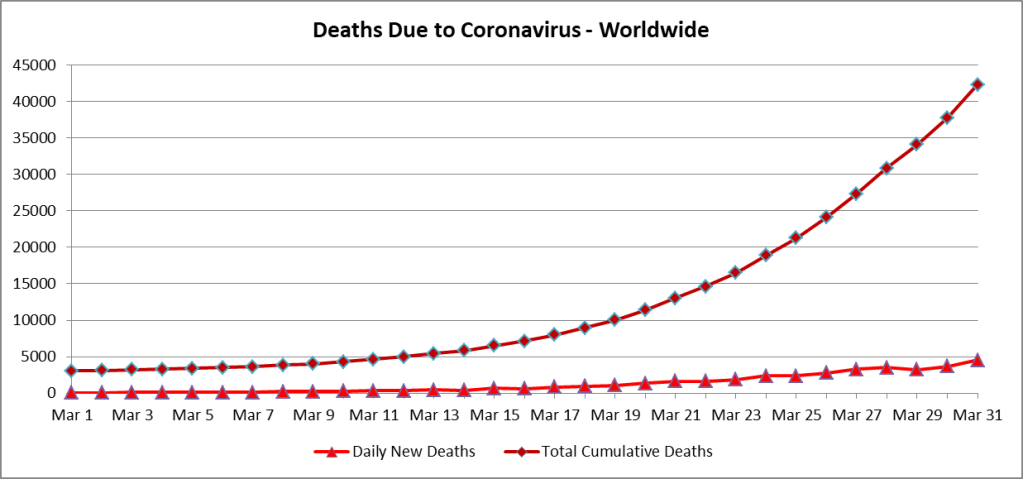
It is also helpful to understand the trends in deaths occurring worldwide due to COVID-19. Fig. 3 depicts this trend during March 2020. As can be seen, the total cumulative deaths due to coronavirus are still increasing and the daily new deaths also exhibit a rising trend.

Fig.3: Deaths Due to Coronavirus – Worldwide.

Source: The author, with data from https://www.worldometers.info/coronavirus/ (accessed on April 1, 2020).

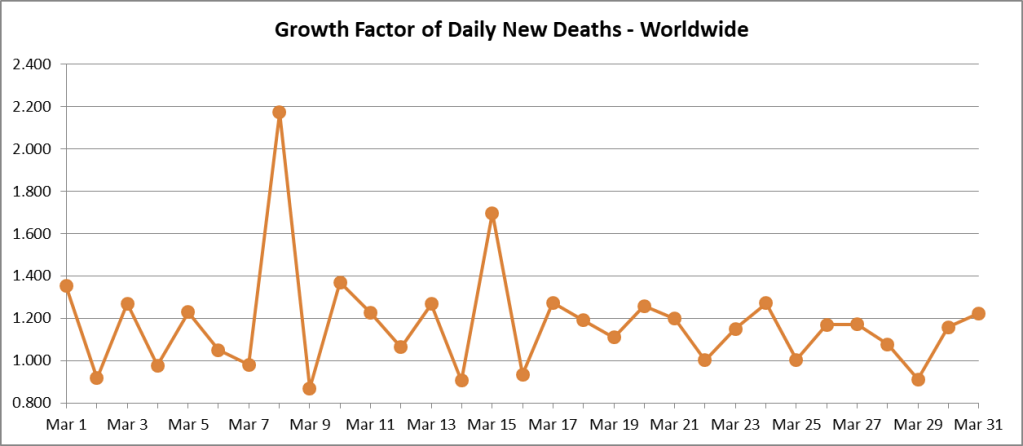
To examine whether the growth in total deaths due to coronavirus is tapering off or still rising exponentially, we turn to the growth factor in daily new deaths. This is depicted in Fig. 4 below. Again, we can see that this growth factor has remained below 1.0 only on 7 days during March 2020 whereas on the remaining days, it has shown a value above 1.0. During the last ten days of the month, this factor has remained above 1.0 on nine days. Hence, the exponential growth phase in total deaths worldwide due to coronavirus may still be continuing.

Fig.4: Growth Factor of Daily New Deaths – Worldwide.

Source: The author, with data from https://www.worldometers.info/coronavirus/ (accessed on April 1, 2020).

In conclusion, as the above analysis shows, we can say that the growth in both the total number of confirmed cases and total deaths worldwide due to coronavirus may still be continuing in the exponential phase. Countries around the world have been taking massive efforts to minimize the surging infections and deaths due to this pandemic. These efforts need to be increased and carefully calibrated to deal with the massive challenge on hand.

(The views expressed in this article are personal).

Featured

The Indian Pharmaceutical Industry: The Next Star On The Horizon

undefined

In the post-liberalization era, the IT sector has been the star performer in the Indian economic growth story in popular perception. The success of the pharmaceutical industry in India during the same period is not so well known, though it has also experienced rapid growth at a CAGR of around 12-15% consistently. The sector was valued at over US $37 billion in 2018. Pharma exports from India reached over US $19 billion in 2018-19 with over 20% of the global exports in generics coming from India. India supplies over 50% of the global demand for all vaccines and over 40% of all generics in the US. 

The Indian pharma sector currently accounts for about 10% of the global pharma industry in terms of volume and around 2.5% in terms of value. It is now ranked the third largest worldwide in volume terms and the 13th largest in terms of value. It is projected to grow to over US$50 billion by 2020. Under the ‘Pharma Vision 2020’, the government is committed to make India as the world’s leading destination for end-to-end drug discovery and innovation by 2020. How can this vision be achieved?   

There are several factors already present that are working to India’s advantage in the pharma sector. These include its ability to produce high quality medicines at comparatively cheaper costs and increasing private sector investments in R&D. Indian pharma companies are now investing around 8.5% of their sales on R&D. India also allows 100% FDI in the pharma sector under the automatic route. With increasing penetration of health insurance and improving drug affordability due to rising economic prosperity, India is well placed for a major expansion in this sector. However, to become the world leader in drug discovery and innovation, several key initiatives by the government and the industry need to be put in place.

Today, India primarily produces branded generics and has limited capabilities in R&D, new drug development and innovation.  As India has already introduced product patents, the Indian pharma companies need to increase their expenditure on R&D significantly to develop new drugs and boost sales.

Secondly, Indian companies also need to focus on diversifying exports beyond generics to gain market share and increase value addition. Currently, the Indian firms mostly focus on conventional tablets and capsules with very little presence in non-conventional dosage forms, advanced formulations and biotech-based medicines. This again requires higher focus on R&D and innovation. The Indian firms also need to expand their presence in new markets, notably in Latin America, Russia and Eastern Europe.

Thirdly, joint ventures with multinational companies can help in improving R&D and new drug discovery. The total cumulative FDI in the pharma sector stood at around US$ 16 billion during April 2000 to March 2019. There is good scope for attracting more FDI in this sector if there is greater focus on R&D and innovation. Expansion by Indian firms through acquisitions in overseas markets can also help in improving efficiencies and gaining market share.

India already has the key growth drivers in place for the pharma sector, both on the demand and the supply sides. On the demand side, rising incomes are improving the affordability of drugs and increasing penetration of insurance is helping in improving access to quality healthcare services. The PM Jan Aarogya Yojana is helping to expand the coverage of health insurance to a much wider section of the population including in the rural areas. The overall government expenditure on health has shown a CAGR of over 12% during the last seven years leading to a significant rise in healthcare services. On the supply side, India is already a major global hub for manufacturing of generics with over 22% of all the USFDA approved plants worldwide. India enjoys a significant cost advantage and the availability of skilled manpower would fuel further growth in this sector. About 120 drugs are expected to go off-patent during the next ten years with estimated US$80-250 billion revenue worldwide, which presents a big opportunity to the Indian firms.

To boost the growth of the pharma sector further, several policy measures need to be taken. These include reduction in time required for approval of new manufacturing facilities and NOC for export licenses, single window clearance mechanism for drug approvals, and support for technology upgradation. The recent move by the government to set up mega pharmaceutical parks would help in reducing dependence on imports of APIs or bulk drugs. The National Biopharma Mission is expected to support the development of biopharmaceuticals and new drug development in India. India already enjoys several advantages in the pharmaceutical sector due to its low cost of production, availability of skilled human resources and world-class manufacturing facilities. However, it needs to significantly boost R&D and innovation and focus on new drug discovery.  If appropriate initiatives by the government and the industry are taken to develop the sector further, it can certainly become the next star on the horizon and make India the world leader in pharmaceuticals.

Source of the image: https://www.europeanpharmaceuticalreview.com/news/65288/indias-pharmaceutical-100bn/

Featured

The Seven Pagodas: An Ancient Abode Of The Gods Called Mamallapuram

undefined

Mamallapuram is in the news globally due to the impending summit of the Indian Prime Minister with the Chinese premier during October 11-12, 2019. Situated on the east coast around 60 kilometres south of Chennai, this ancient town has a rich history dating back to the 1st century BC. Declared as a UNESCO World Heritage Site, the town is a major tourist attraction in the state of Tamil Nadu in India.

Mamallapuram was a major seaport during the first millennium CE and the region thrived during the reign of the Pallavas. It was founded by the Pallava king Narasimhavarman I during the 7th century AD. The name of the town itself is perhaps derived from “Mamallan”, meaning a great warrior, a reference to Narasimhavarman I. It was ruled by the Pallava kings from Kanchipuram, the capital of their kingdom, from the 3rd to the 9th centuries AD. They used the port as a major trading centre with Sri Lanka and South-East Asia. The port was also an active hub of global trade during this period as Chinese and Roman coins from the 4th century AD have been found at this place.

The town was also known by several other names during ancient times, such as Mamallapatinam and Mahabalipuram. The ancient town had seven pagodas on the shore, of which only one, known as the Shore Temple, now survives. Due to these seven pagodas, the town was also known as The Seven Pagodas to the ancient mariners.  

The temples at Mamallapuram depict events mainly from the Indian epic Mahabharata and were built largely during the reign of Narasimhavarman and his successor Rajasimhavarman. There are 32 monuments in the town spread over an area of around four square kilometres. The major monuments include rathas or temples in the form of chariots, mandapas or cave sanctuaries, massive open-air rock reliefs such as the Descent of the Ganges, and the famous 7th century Shore Temple dedicated mainly to Lord Shiva and Lord Vishnu.  

The Chinese Connection

Mamallapuram also has a significant historical connection with China. The port was a major trading hub with China, Sri Lanka and South-East Asian countries. The Chinese traveller Hiuen Tsang is said to have visited the town. It is also believed that Bodhidharma, a famous Buddhist Monk in China, was a son of a Pallava king who travelled to China from Mamallapuram in the 6th century AD.

With its rich history and historical connections with China, Mamallapuram is the most appropriate place for a historic summit between the leaders of the two most populous nations and emerging superpowers in the world.

Source of the Photograph: http://www.traveltriangle.com

(The author is a senior IAS officer in Tamil Nadu and is currently working as the Principal Secretary, MSME Department. The views are personal).

Featured

Single Window Portal: Improving the Ease of Doing Business in Tamil Nadu for the MSMEs

Introduction

The Micro, Small and Medium Enterprises (MSME) sector is an important, highly vibrant and dynamic sector of the Indian economy as it has contributed greatly to the economic growth over the years. The MSMEs manufacture more than 6000 products, contributing about 45% to manufacturing and around 40% to exports. With its agility and dynamism, the sector has shown an admirable innovativeness and adaptability to survive the recent economic scenario. It is the MSME sector which can help realize the target of the National Manufacturing Policy of raising the share of manufacturing sector in GDP from 16% at present to 25% by the end of 2022.

MSMEs in Tamil Nadu

There has been a phenomenal growth of MSMEs in Tamil Nadu. MSMEs produce a wide variety of products in almost all sectors. The prominent among them are textile, garments, engineering products, auto components, leather products, plastics, etc. 

Around 20.13 lakh entrepreneurs have filed the Entrepreneurs’ Memorandum (EM) Acknowledgement Part-II and Udyog Aadhaar Memorandum (UAM), providing employment opportunities to about 128.91 lakh persons with a total investment of over Rs 2.23 lakh crores.

Improving the Ease of Doing Business

The Government of Tamil Nadu has enacted the Tamil Nadu Business Facilitation Act, 2018 to enhance the ease of doing business in the state. The Act provides for single point receipt of applications for securing clearances that are required to establish or expand an enterprise and for those required during the normal course of business including renewals in a time-bound manner. The Act also provides for an effective grievance redressal mechanism and fine in case of failure of Competent Authorities to act within a time frame and for matters connected therewith or incidental thereto.

The Act covers 54 clearances which include pre-establishment, pre-operation, renewals, incentives, etc. District Industries Centres and Guidance Bureau are designated as the Nodal Agencies for MSMEs and large industries respectively for operating the single window mechanism.

The Act provides for a 3 tier institutional structure to monitor and review the progress of single window mechanism for the MSMEs:

  • District MSME Single Window Committee
  • State MSME Single Window Committee and
  • MSME Investment Promotion and Monitoring Board.

Single Window Portal

The Commissionerate of Industries and Commerce of the Government of Tamil Nadu has taken a number of steps to improve the ease of doing business and create an investor-friendly climate in the state to promote investments in the MSME sector. The most important initiative in this regard has been to create an online Single Window Portal exclusively for the MSMEs to enable them to obtain approvals and ‘No Objection Certificates (NoCs)’ from various government departments and agencies for establishing their enterprises. It allows the MSMEs to obtain all the approvals and NoCs through a single Composite Application Form (CAF) from 12 government departments and agencies in the state including the Directorate of Town and Country Planning (DTCP), Tamil Nadu Pollution Control Board (TNPCB), Fire Department, Directorate of Industrial Safety and Health (DISH), Public Health, Rural Development and Panchayati Raj (RD&PR) and Tamil Nadu Generation and Distribution Corporation Limited (TANGEDCO). The approvals cover pre-establishment, operation and renewal stages and the entire process is completely online including payment of fees. All the departments and agencies are required to give approvals online within a defined time-frame after the complete application has been submitted. The application need not submit any paper documents and need not visit any government office in person.

The portal may be accessed at https://easybusiness.tn.gov.in/msme/.  The portal has the following features:

  • Single point acceptance and electronic distribution of applications to the respective Competent Authorities without the need for applicants to physically visit the concerned offices.
  • Custom generation of forms for individual Competent Authorities along with requisite attachments.
  • Single point of capture of information with the feature of auto-population of data.
  • Online approval by the concerned Competent Authorities and provision to download the certificate online.
  • Online tracking/automatic alerts to applicants through SMS/emails.
  • Customized online MIS reports for monitoring at different levels.

Online Implementation of All Schemes and Incentives for MSMEs

The Commissionerate of Industries and Commerce has taken another major step towards improving the ease of doing business in the state for the MSMEs by making the implementation of all the schemes and incentives for them completely online. The portals for the various schemes and incentives are given below:

Loan Schemes:

  1. NEEDS : https://msmeonline.tn.gov.in/needs/index.php
  2. UYEGP: https://msmeonline.tn.gov.in/uyegp/index.php
  3. PMEGP: https://www.kviconline.gov.in/pmegpeportal/pmegphome/index.jsp

Incentive Schemes:

  1. Capital Subsidy: https://msmeonline.tn.gov.in/incentives/capital/index.php
  2. LTPT Subsidy: https://msmeonline.tn.gov.in/incentives/index.php
  3. Generator Subsidy: https://msmeonline.tn.gov.in/incentives/index.php
  4. Interest Subvention:               https://msmeonline.tn.gov.in/incentives/is/index.php
  5. Promotion of Energy Audit and Conservation of Energy (PEACE):                             https://msmeonline.tn.gov.in/incentives/index.php
  6. Amma Skill Training and Employment Scheme: https://msmeonline.tn.gov.in/ammaskill/index.php

It is relevant to note that all the above initiatives have been implemented with full involvement of all the relevant stakeholders, e.g., MSME associations at the state and district levels and the District Industries Centers in the districts. In recognition of its successful efforts to implement the Single Window Portal and transform the implementation of various schemes and incentives for the MSMEs through online applications, the Commissionerate of Industries and Commerce has been awarded the ISO 9001:2015 certification by the Bureau of Indian Standards (BIS) in July 2019.

Conclusion

Tamil Nadu is a leading state in the country in the MSME sector, both in terms of its overall size and the varieties of products that it produces. It is poised to achieve even greater heights in the years to come with a number of initiatives already being implemented in the state to improve the ease of doing business for the MSMEs. The Commissionerate of Industries and Commerce is actively working with all the stakeholders in the MSME ecosystem in the state to ensure that it is able to support the growth of the sector even further.

(The author is a senior IAS officer in Tamil Nadu and is currently working as the Principal Secretary/Industries Commissioner and Director of Industries and Commerce, Government of Tamil Nadu. The views are personal.)

Digital India 2.0: Digital Transformation for Viksit Bharat @2047

Digital Transformation and Economic Growth

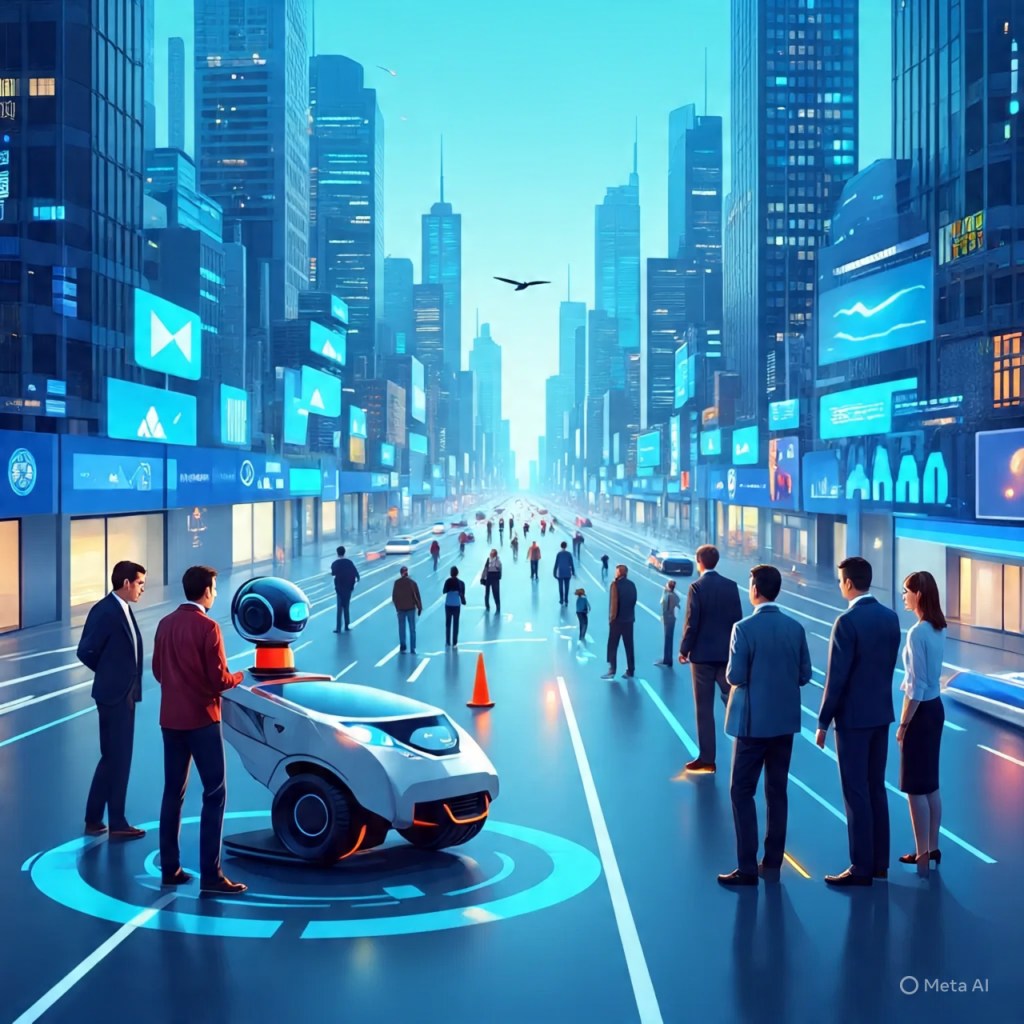
Source: Generated using Meta AI by the author

Viksit Bharat @2047 aims to transform India into a developed nation by 2047. Broadly, the vision of Viksit Bharat can be divided into five key thematic areas: thriving and sustainable economy; empowering citizens; innovation, science and technology; good governance and security; and enhancing India’s global standing. As India has achieved remarkable success in digitalising its economy under the Digital India programme, can this programme be reimagined to leverage digital transformation in these areas to achieve the vision of Viksit Bharat?

Digitalization can significantly contribute to a thriving economy. India’s over $400 billion digital economy in itself is a major contributor to the overall economy and its continued growth is essential for achieving the vision of Viksit Bharat. Digital public infrastructure (DPI) like Aadhaar and UPI have revolutionalised online identity authentication and payments and have empowered individuals and businesses. Similar DPI initiatives, public-private partnerships (PPPs) and leveraging Artificial Intelligence (AI) and other emerging technologies can digitally transform sectors like manufacturing, healthcare, education, agriculture, etc. and enhance economic growth. 

Improving access to digital services and infrastructure and digital empowerment through initiatives like BHASHINI can enhance digital inclusion, particularly for disadvantaged communities.  

Digital transformation is also essential for fostering innovation and technological advancement. It can also be used to promote green technologies and sustainable practices. Smart cities initiative is already showing how scalable digital transformation and PPPs can address challenges like sustainable urban planning and climate change. Digitalisation can also enhance good governance and improve India’s standing as a global leader in sustainable economic growth.

To achieve the vision of Viksit Bharat and create such an economy and society wide impact over the next two decades, the Digital India programme needs to be reimagined as a cross-sectoral mission based on a whole of government and whole of society framework.

This new mission, Digital India 2.0, needs to be architected on certain key foundations for accelerating digital transformation across various sectors. First, it needs to focus on creating world-class digital infrastructure including AI-ready data centres and high-speed connectivity through fibre and mobile reaching all villages. With AI emerging as a key platform technology that would drive transformation across various sectors in future, the need for making India a global hub for AI-ready data centres with high-performance hardware and robust network infrastructure cannot be overemphasized. Expansion of data centre infrastructure would also address the need to ensure data privacy, security and data storage within the country.

Second, digital government and digital services need to undergo a major transformation through a focus on delivering integrated, pro-active and personalised services using AI. This would require building a unified AI stack as a digital public infrastructure (DPI) comprising AI-ready data centres, access to curated data sets, and AI models and applications to enable the ministries and departments to develop their own use cases quickly. 

Third, the growth of the digital economy needs to be accelerated so that its share increases to at least 25% of the overall GDP of $30 trillion by 2047 from its present level of around 11%. This requires sustained growth in electronics and semiconductors, IT-ITES, and emerging technologies, such as AI, 6G, quantum computing, IoT, etc. However, a major contribution to the growth of the digital economy is likely to come from digitalisation of the traditional sectors, e.g., agriculture, health, education, financial services, retail, etc. Building a vibrant start-up ecosystem in these domains is essential for achieving this goal.

Fourth, we need to revamp our legal and regulatory framework to support the rapid growth of the digital economy. The major issues that need to be addressed include concerns on data privacy, cyber security, accountability of online platforms including social media, and fairness and transparency of AI algorithms. Though privacy concerns have been addressed through the new Digital Personal Data Protection (DPDP) Act, a full revamp of the 25 year old IT Act needs to be undertaken to address these issues comprehensively.

Fifth, rapid advancements in strategic and emerging technologies with ownership of intellectual property is a sine qua non for becoming a global leader in digital economy. We need to quickly formulate national strategies in these critical areas and fund the flagship initiatives. The IndiaAI Mission is a step in the right direction. However, we need to build our own foundational models in AI to ensure strategic autonomy in this rapidly advancing technology. Similarly, a national policy on data governance also needs to be formulated to ensure easier access to data by all the ministries, states, industry, start-ups, researchers, etc. This would allow rapid innovations to happen in these technologies.

Last, but not the least, skilling and capacity building in digital technologies at all levels is vital for rapid growth in the digital economy. India should rightly aim at becoming the skill and talent capital of the world.

Digital India 2.0, with its focus on a whole-of-government and whole-of-society approach, can accelerate digital transformation across various sectors to achieve the vision of Viksit Bharat.

(The views expressed are personal.)

Transforming Governance with a Unified AI Stack

Source: Generated through AI by the author

With rapid advancements in artificial intelligence (AI), organisations are scrambling to implement the technology in their business processes and service delivery frameworks to improve efficiency and enhance citizen experiences.

AI is set to impact nearly every sector, but to harness its potential, organisations need an ‘AI-first’ strategy that includes scalable, flexible AI solutions for business transformation. This requires an integrated AI stack — comprising infrastructure, data, AI models, and applications — enabling AI deployment across various use cases. Can such an AI stack be developed as a digital public infrastructure (DPI) by the government to provide seamless, proactive services to citizens and businesses?

To create a DPI, it is essential to understand the components of an enterprise-level AI stack. The foundation of this stack is a compute infrastructure layer, which includes compute capacity, storage, networking and tools for developing, training and deploying AI models. This layer would utilise Graphics Processing Units (TPUs), Central Processing Units (CPUs) and Tensor Processing Units (TPUs) optimised for AI workloads. Cloud platforms offer scalability, while edge computing may be necessary for real-time services in remote or low-bandwidth environments.

The second layer consists of the data layer, which focuses on collecting, storing, cleaning and annotating data for use by the AI models. Data security and compliance with the privacy laws must be ensured through encryption, anonymisation and access control. Data comes from various sources like structured and unstructured databases, web, Internet of Things (IoT), Application Programming Interfaces (APIs), etc. It must be cleaned and prepared for the AI model training to enhance accuracy and fairness. Ministries and departments have created huge databases under the Digital India programme that can be shared to train AI models for delivering predictive and proactive services to citizens and businesses.

The next layer is the model development layer, which focuses on designing and training models on the processed data from the data layer to address specific use cases, such as text or image/video generation, predictive analytics, etc. This involves selecting suitable AI frameworks, libraries, algorithms for the type of AI tasks involved, their optimisation and validation. Many open-source options, including pre-trained foundational models, can be customised for specific domains. However, developing indigenous foundational models is crucial to ensuring strategic autonomy and creating world-class capabilities within the Indian technology ecosystem. This doesn’t need to be resource-intensive, as demonstrated by DeepSeek.

The developed AI model is then deployed or exposed through APIs or microservices enabling integration with the enterprise systems, web and mobile applications. Next comes the application layer, which integrates AI models into real-world systems to deliver AI-enhanced products and services. This may involve reengineering business processes, automating tasks and redesigning user interfaces. For example, an AI application for predictive analytics might generate advance warnings for heavy traffic at specific locations during peak hours and send automated alerts for immediate action.

Finally, the AI stack also needs to have a governance layer to ensure that the associated risks, if any, are managed and trust is built in the AI systems. The government’s IndiaAI Mission should focus on creating a common AI stack as DPI, which all ministries and departments can use to build their own AI applications. This will prevent duplication of efforts and resources and create a vibrant innovation ecosystem focused on transforming public services with an ‘AI-First’ strategy. The AI stack could also be made available to startups and the private industry to promote collaborative development and deployment of AI applications.

(The above article appeared in The Economic Times on February 9, 2025. It is available at https://economictimes.indiatimes.com/tech/artificial-intelligence/transforming-governance-with-a-unified-ai-stack/articleshow/118073623.cms?from=mdr. The views expressed are personal.)

Transforming Governance through AI

Source of the image: Generated through AI by the author

Artificial intelligence (AI) technologies have the potential to transform governance and bring about a paradigm shift in citizen-centric delivery of services. Imagine a student applying for college admissions. Instead of separately applying for numerous universities and colleges with the need for filling multiple applications with repetitive data each time, an AI-driven system would proactively collate the basic demographic information about the student and suggest the probable list of colleges based on his/her score in the qualifying examination. It would even fill out a common application form for admission to various institutions and automatically apply for various scholarships for which the student might be eligible based on demographic and income criteria. At the other end, the selection and allotment of seats by the universities and colleges would become much easier and faster with the AI-driven system seamlessly sorting the preferences, allocating seats and awarding eligible scholarships to each student. The above system can easily be operated at the state and national levels. The resultant savings in time, cost and efforts for all the stakeholders would be enormous.

The above vision of an AI-driven and proactive governance can easily be replicated in many other domains, e.g., health care, agriculture, crime detection and prevention, cyber security, etc. In health care, AI can help in much faster diagnosis and detection of diseases through analysis of scans, etc. enabling better treatment, remote care, and substantial savings in time and cost for the patients and hospitals. Similarly, predictive data analytics can provide deep insights into patterns of crime and suggest more effective prevention strategies through proactive policing. AI algorithms can analyse traffic flow patterns and suggest better route planning and optimization to reduce congestion. AI-enabled chatbots can provide very specific and contextualized responses in multiple languages to queries from citizens and even deliver a wide range of citizen-centric services, e.g., access to various certificates, education and medical records, etc. They can become invaluable tools in information dissemination and driving citizen engagement.

AI can also enable transformation of the government itself through smarter policy formulation driven by predictive analytics and evidence-based decision making. It can help in formulating proactive strategies and implementing an agile framework for governance.

As outlined above, AI-driven governance can herald a new era of transformation, innovation and efficiency. However, to achieve this vision, the government must take a number of enabling policy initiatives.

First, it must ensure that there are adequate investments in AI focused compute infrastructure and R&D by both the public and private sectors to fuel innovation and development of new applications. Government driven investments in AI infrastructure and R&D will also help in creating a vibrant startup ecosystem in India that can focus on developing AI based applications in various domains.

Second, the government must evolve and put in place a regulatory framework for AI that encourages innovation while at the same time recognizing and mitigating the risks that may be associated with the development and implementation of AI technologies and applications.

Third, the government must enable access to large amounts of anonymized domain datasets which the concerned central ministries and states have built in the course of implementing a very large number of e-governance projects over the past few decades. This will enable the industry and startups to develop and train innovative AI applications for various domains.  

Fourth, the industry must focus on ethical development and deployment of AI applications. This would ensure transparency and accountability in the entire process allowing for identification and mitigation of any biases and promotion of fairness and trust amongst all the stakeholders including the end-users.

Fifth, privacy preserving technologies and stringent data security protocols must be followed in the development and deployment of AI applications. This will help in mitigating any risks of data breaches and cyber frauds. It is also essential that all precautions to ensure cybersecurity in the entire infrastructure and application ecosystem are taken.

Last but not least, skilling for AI to meet the burgeoning needs of the industry is of paramount importance. Our best technical institutions must focus on advanced education and R&D while the industry can focus on targeted training programmes in niche areas to build adequate human resource capacity in AI. While India is a global leader in information technology services, when it comes to government readiness for AI, a recent report by Oxford Insights ranks India at the 40th position out of 193 nations. For making India a global leader in AI, it is the right time to focus on AI-driven governance for transforming the government and reimagining public service delivery.

(The above article appeared in The Economic Times on 28th June, 2024. It is available here: https://economictimes.indiatimes.com/tech/artificial-intelligence/transforming-governance-through-ai/articleshow/111543404.cms?from=mdr. The views are personal.)

Writing the New Rules for AI

Regulating AI

Source: https://www.istockphoto.com/photos/ai-regulation

The launch of ChatGPT in November 2022 heralded a new era in democratizing the use of artificial intelligence (AI). Since then, use of AI has quickly expanded across many sectors, including healthcare, education, financial services, public safety, etc. However, rapidly advancing capabilities of AI have also brought to the fore the criticality of safety and ethical use of these technologies. At the Global Partnership for Artificial Intelligence summit in 2023 in New Delhi, the Hon’ble Prime Minister stressed the importance of creating a global framework for ethical use of AI, including a protocol for testing and deploying high-risk and frontier AI tools. Earlier, at the first global AI Safety Summit 2023 at Bletchley Park, 28 countries gave a call for international cooperation to manage the challenges and risks of AI.

How can a global framework for safe and ethical use of AI be developed? Several countries have initiated efforts to regulate and govern AI. The US government issued an executive order in October 2023, focusing on safe, secure and trustworthy development and use of AI. It seeks to address several critical areas, including national security, consumer protection, privacy, etc. and requires AI developers to share safety results with the US government. EU’s AI Act adopts a risk-based regulatory approach with stricter oversight for higher levels of risk of the AI systems.

At a fundamental level, a global framework for governance of AI must address the key concerns regarding development, deployment and use of AI. These include dealing with machine learning biases and potential discrimination, misinformation, deep fakes, concerns on privacy and access to personal data, copyright protection, potential job losses, and ensuring the safety, transparency and explainability of the AI algorithms.

The goal of AI governance should be to promote innovation and ensure safe, fair and ethical applications of the technology in promising sectors. To address the concerns noted above, the framework for governance of AI must be based on certain core principles, which can be enumerated as below.

Innovation: The governance framework must promote innovation and competition in AI technologies to continuously improve them. This would require, for example, facilitating access to large amounts of anonymized datasets to startups for developing and training AI applications in various domains. The National Data Governance Policy of GoI is an excellent initiative in this direction.

Infrastructure: The framework must also support expanding access to compute infrastructure and AI models to promote competition and encourage innovation. This would particularly be helpful to startups in this domain.

Capacity Building and Engagement: A sustainedfocus on capacity building holds the key to involving and engaging with more stakeholders in the development and deployment of AI across multiple sectors. This can significantly help in managing and reducing the risks. Engaging with stakeholders would also help in addressing any potential job losses and worker displacements due to deployment of AI.

Safety and Risk Management: This would involve development of standards and ensuring that AI models are tested and assessed for safety and risk. Appropriate risk management strategies must be put in place to address any likely harms that may be caused. This would include ensuring transparency, fairness and explainability in the AI development lifecycle through selection of proper training data sets, removing any biases and ensuring that cybersecurity issues have been addressed.

Privacy Protection: AI models must focus on privacy preserving technologies to ensure protection of privacy. This would help in creating trust in these models and enhancing their beneficial impact.

International Cooperation: For any global framework to succeed, international collaboration and partnerships built on a shared vision and common goals are essential. A global framework on AI must build on evidence in this rapidly evolving technology and promote collaboration across all countries to become effective.   India, being a global leader in technology, can play a proactive role in developing a global framework for governance of AI based on the key principles enumerated above. With its huge technology talent base and a rapidly growing economy, India enjoys a unique advantage in the global technology ecosystem, which it can leverage in this direction. We also need to focus on the development of AI applications trained on Indian data sets in various domains, such as agriculture, education, health care, transportation, public safety, etc., which can play a huge role in revolutionising the entire citizen-centric service delivery paradigm and bring efficiency gains at a systemic level across multiple sectors.

(The above article appeared in The Economic Times on January 28, 2024. It is available here: https://economictimes.indiatimes.com/tech/catalysts/writing-the-new-rules-for-ai/articleshow/107192031.cms?from=mdr. The views are personal.)