
A Holistic Approach to Personal Data Protection

Source: https://www.pexels.com/

After detailed deliberations, the Joint Committee of Parliament on the Personal Data Protection Bill has made several important recommendations, and a debate is currently raging in the country over some of those proposals.

The Committee’s recommendations need to be understood in the broader context of personal data protection and to support the growth of a robust innovation and data-driven digital economy.

The Committee has proposed to include a new clause to include non-personal data within the ambit of the Bill, since renamed as Data Protection Bill, 2021.

This has been done to take a holistic approach towards processing of data, both personal and non-personal, as with the advent of advanced technologies like artificial intelligence and sophisticated data analytics, it may not be too difficult in future to relate anonymised personal data (a form of non-personal data) to individuals.

However, the revised Bill only contains a provision for formulating rules regarding non-personal data at a later stage. Currently, it does not have any substantive provisions in this regard.

A key provision in the Bill to allow certain exemptions to the government data fiduciaries has generated a lot of discussion.

The exemptions under Section 35 of the Bill need to be on a case-to-case basis and only on the grounds of sovereignty and integrity of India, security, etc. which are within the ambit of reasonable restrictions under Article 19(2) of the Constitution.

Further, the reasons for exemptions have to be just, fair, reasonable and proportionate which are as per norms laid down by the Supreme Court in its 2017 privacy judgement in the Puttaswamy case.  

The exemptions under Section 12 are narrower and more specific for facilitating better delivery of government services, disaster management, dealing with epidemics and medical emergencies, etc.

Government entities are not exempted from their obligations as data fiduciaries and complying with the rights of data principals in general. There are adequate safeguards in the Bill to prevent any misuse of such exemptions, including oversight by the Data Protection Authority (DPA).    

Another recommendation that has generated much debate relates to making social media platforms liable for content hosted on their platforms from unverified accounts and making verification of accounts mandatory.  

However, this is only for those platforms that do not act as intermediaries eligible for safe harbour as per Section 79 of the Information Technology Act, 2000. This is only a recommendation that needs to be examined by the government later and is not part of the revised Bill.  

Concerns have also been raised over the compliance burden on startups and its impact on innovation.

To address this concern, the Bill places much greater emphasis on compliance by the significant data fiduciaries with additional obligations, such as periodic audits, appointment of data protection officers, etc. Startups and small businesses do not need to comply with these additional obligations as they would not be classified as significant data fiduciaries.

The Bill also provides for the creation of a sandbox to encourage innovation. Processing of personal data of foreign nationals is also exempted under the Bill.

Another key concern is regarding the provisions for data localisation.

Section 33 of the Bill makes it clear that sensitive personal data shall continue to be stored in India, while Section 34 allows its transfer outside India under certain conditions.

The EU GDPR places similar conditions on data transfer to only those countries which fulfil the ‘data adequacy’ norms.

These provisions will make it easier for Indian entities to attract more outsourcing business from abroad as India would fulfil these norms. Storage of sensitive personal data within India would support the growth of hyperscale data centres and an innovative data-driven economy.

Concerns have also been raised over another recommendation relating to norms for testing the integrity of hardware and software on devices.

This has been done to prevent any unauthorised data breaches through insertion of any untrusted hardware. This provision has been added within the scope of functions of the DPA under Section 49 and can be implemented only after the DPA formulates an appropriate code of practice in consultation with the relevant stakeholders.   

The concept of privacy has evolved from the Aristotelian concept of idios, meaning “one’s own” or “private”, in ancient times to its modern-day focus on informational privacy.

The Data Protection Bill, 2021 provides a holistic framework for addressing informational privacy that will also help greatly in the growth of a robust digital economy in India.

(The above article appeared in The Economic Times on January 9, 2022 and is available at: https://economictimes.indiatimes.com/tech/catalysts/ettech-opinion-a-holistic-approach-to-personal-data-protection/articleshow/88775228.cms?from=mdr. The views are personal.)

The Race for Global Leadership in AI: Where Does India Stand?

Photo by Tara Winstead on Pexels.com

Over 50 countries around the world have announced their own national strategies on Artificial Intelligence (AI) and many others are rushing to do so. AI holds great potential as the key driving force for the next phase of economic growth led by technological innovation and no nation wants to be left behind. However, which countries are early movers in the global AI sweepstakes and where does India stand in the race for global AI leadership?

AI generally refers to capability of machines to mimic human-like cognitive functions, such as learning, thinking and problem solving. It comprises a suite of technologies, e.g., machine learning, deep learning, speech recognition, image processing, etc. that underpin broader technologically driven transformations happening in diverse domains: education, healthcare, industry 4.0, autonomous vehicles, etc. AI also has huge potential military applications in the development of autonomous weapons. There is a growing feeling in many countries that leadership in AI would be crucial in determining strategic and geopolitical influence in future, both at regional and global levels.

Several countries and jurisdictions, such as USA, China, European Union, UK, etc., have already announced their national AI strategies and are early movers in this rapidly evolving technology. Most of them have tried to leverage their own strengths to advance their capabilities in AI. However, they all focus on certain common key elements in varying degrees in their strategies: research and development (R&D), skilling, building data ecosystems, developing computing and network infrastructure, collaborative partnerships, ethics, and regulation.

The US launched its first federal initiative on AI in 2016 and a revamped initiative in 2019 with focus on five key elements: R&D, technical standards, training, promoting public trust and confidence, and protecting the American technological advantage while promoting international collaboration. It has generously funded its AI initiative, with a total budget of approximately $1 billion for non-defence AI R&D in 2020. It had also committed $2 billion over five years on AI R&D in defence in 2018.

The European Union (EU) first published its Coordinated Plan on AI in 2018. It has published an updated plan in April 2021 that focuses on four key components: AI development and implementation, R&D and building data ecosystems, skilling and fostering trust in AI, and building strategic leadership in high impact sectors such as climate, health, and mobility. The public and private funding for AI is estimated to be around EUR 20 billion per year till 2030.

China announced its “New Generation Artificial Intelligence Development Plan” in 2017 with the overarching goal of becoming the world leader in AI by 2030 by creating a trillion Yuan (approx. US$ 150 billion) AI industry in China. The plan focuses on developing and deploying AI in a wide range of economic sectors including defence. While the plan and the strategy are central, the implementation is to be done by the local governments and the private sector. The total national and local government funding on AI programmes is estimated to be in the range of tens of billions of US dollars.

The UK announced its AI Sector Deal in 2018 with the key goal of becoming the world’s most innovative economy in AI. It focuses on education and training, R&D, promoting networking and partnerships, regulation to build trust, developing open data ecosystems, and networking and computing infrastructure. The total funding commitment for the strategy is around GBP 2.7 billion.

Where does India stand in the global race for leadership in AI? The NITI Aayog’s discussion paper on national strategy on AI in 2018 focuses on leveraging AI for inclusive growth and mentions five key domains: healthcare, education, agriculture, smart cities, and transportation and mobility. It also notes five key barriers to excellence in AI that need to be addressed: lack of R&D expertise, lack of high-quality datasets, lack of a regulatory framework on privacy and security, high resource cost and low awareness, and absence of a collaborative approach to adoption and applications. It proposed setting up of five centres of research excellence and 20 centres for transformational AI with a total funding of around Rs. 7,000 crores. However, though the strategy paper was published in 2018, India is yet to launch a comprehensive and coordinated national programme on AI. One study by Oxford Insights placed India at the 40th position in the world in the Government AI Readiness Index out of 172 countries, a drop of 23 places from the 2019 rankings. Though India currently ranks third in the world in terms of total number of research publications in AI, we need to quickly formulate and implement a well-designed national programme on AI with adequate funding to become a global leader in this strategic technology. This is eminently possible if we can leverage our strengths in R&D due to a strong network of academic and research institutions, availability of a huge talent base and high-quality datasets in diverse domains, and presence of a globally competitive IT sector within the country.

(The author is a senior IAS officer and is currently working as Additional Secretary in the Ministry of Electronics and IT. The views are personal.)

The above article appeared in The Economic Times on 22 August, 2021. The link is here: https://economictimes.indiatimes.com/tech/tech-bytes/the-race-for-global-leadership-in-ai-where-does-india-stand/articleshow/85520265.cms

Empowering the Poor Through Mobiles

Can a simple device like a mobile phone be used for empowering the poor and the marginalized? Consider this: an NREGA worker receives her weekly wages in her bank account. However, she has no way to check the amount credited unless she visits the bank branch or goes to an ATM. Doing so may involve substantial costs in travel and lost wages as they are most likely to be located far away from her village. However, if her bank account is mobile enabled, she can do virtually all the transactions through a simple SMS or voice based interface in her own language.

There are myriad other ways in which a mobile phone can empower the poor. A Primary Health Centre (PHC) in a rural area can send SMS or voice alerts to all pregnant women for scheduled health check- ups. The same can be done for immunizations for children. A health worker can visit the households in her village with a low-cost mobile phone or a tablet with an application to capture all the information about the health status of the family and the data can be transmitted to the backend server in real time. All this can dramatically improve the outcomes of programmes like the National Rural Health Mission. Similarly, for all sales of commodities under the PDS, SMS alerts can be sent to the ration card holders to keep a check on fraudulent withdrawals. A citizen will also be able send a complaint about deficiency in any service far more easily using a mobile phone. All this information can be captured and made available to the concerned government departments in real time and can be monitored from anywhere. Imagine the impact it will have on transparency, accountability, and quality of service delivery across the board. Improving the systemic accountability and bottom-up participation of citizens in governance are sure shot ways to improve the quality of governance and make a substantial dent in the all-pervasive corruption.

How can all this be made possible? Mobile phones are ubiquitous in India today with over 900 million subscribers, of which over one third are in rural areas. The reach of mobiles is much greater than that of computers and internet. They have relatively low physical infrastructure requirements and are more cost-effective in remote areas. SMS and voice are powerful mobile technologies that do not require internet connectivity to work. This can prove to be a boon in rural and remote areas. With the falling prices of mobile devices, endless possibilities have emerged for their use in significantly enhancing the outcomes of social and economic development programmes. Their entry barriers are low as they require only basic literacy for use and offer affordable, portable, and real-time access to communication and information to the people who previously had no access to such communication modes. 

Mobiles can be used for enhancing developmental impacts in diverse sectors such as health, education, agriculture, animal husbandry, etc. They can help in combating poverty by improving the delivery of services in these areas. Tablets can significantly enhance the educational experience of students through well-designed content. Mobiles can also act as potent instruments for saving lives by sending warnings and alerts in disasters and crisis situations. They can also be used as tools for economic empowerment for the farmers and poor micro-entrepreneurs in rural areas by reducing information asymmetries as market information can be accessed almost instantly reducing travel expenditures and increasing speed of trade.  For women, they allow greater independence and enhanced security and can be used to monitor violence against them.

Mobile technologies can also be used in new and innovative ways to engage with citizens and stakeholders, for example in holding consultations and gathering feedback. They can help in strengthening the demand side of governance by allowing the citizens to engage with public institutions and demand better services. This can foster transparency and accountability and generate new possibilities for open government. They can also enable disintermediation in the delivery of services by facilitating direct contact with the citizens.

M-governance is an umbrella term that covers the use of mobile technologies (e.g., SMS, USSD, voice, location, mobile applications, etc.) to enhance the governance and developmental impacts in various domains. While deeply intertwined to e-governance, it has emerged as a separate domain aimed specifically at addressing the digital divide in access to government services and programmes. However, by themselves, they cannot be effective in development or governance. To make them act as catalysts in this process, policies need to be in place to support access to information, development of relevant content and services in the local languages, an enabling infrastructure, and an effective awareness and communication campaign aimed at the end users.  Recent initiatives by the RBI for mobile based financial inclusion and by the Department of Electronics and IT to make mobile based provisioning of government services mandatory by all government departments and agencies offer great hope to achieve this vision.

(The above article was published on February 27, 2013 in The Hindu. It is available at: https://www.thehindu.com/todays-paper/tp-features/tp-opportunities/empowering-the-poor-through-mobiles/article4457237.ece)

Foundation for a Future India: Digital India

India today ranks amongst the largest economies of the world and has become the fastest growing large economy. However, it is still a lower middle income country in terms of per capita income with substantially high levels of poverty and deprivation and significant regional imbalances in development. The vision of a future India must aim at holistic development in all sectors of the economy and society so that overall human development and quality of life is improved in the country.

Can technology led transformation lay the foundation of a future India?  In this article, I examine this central question with reference to the recently launched Digital India programme of the Government of India that aims at transforming the country into a digitally empowered society and knowledge economy. The programme weaves together a large number of ideas and thoughts into a single, comprehensive vision so that each of them is seen as part of a larger goal. The focus of Digital India is on being transformative – to realize IT (Indian Talent) + IT (Information Technology) = IT (India Tomorrow) and on making technology central to enabling change.

This futuristic vision of the programme is centred on three key areas, namely, digital infrastructure as a utility to every citizen, governance and services on demand and digital empowerment of citizens. The idea is to transform the entire ecosystem of public services through the use of information and communication technologies (ICT) and build holistic capabilities across a wide range of sectors, e.g., ICT infrastructure, e-governance, software services and delivery platforms, electronics manufacturing, Internet of Things (IoT), IT skills and job creation, etc. The focus is on making ICT as a key driver for transforming every sector of the economy and society. In order to achieve this futuristic vision for a developed India, Digital India focuses on several key developmental strategies. These include promoting investments through improving ‘ease of doing business’, encouraging entrepreneurship across various sectors through leveraging IT, capacity building and creation of jobs in the IT sector, providing easy access to public services anytime from anywhere, promoting financial inclusion through mobile banking and micro ATMs, promoting literacy through e-books and other digital contents, faster services and dissemination of information to promote growth in diverse sectors such as agriculture, education and healthcare, and encouraging more participation from women in various sectors of the economy and society. 

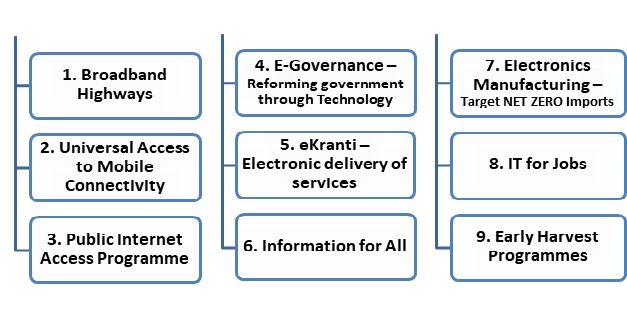
In order to lay the foundation for future India, Digital India has identified nine key pillars of growth areas. These include broadband highways, universal access to mobile connectivity, public internet access programme, reforming government through technology, electronic delivery of services, information for all, electronics manufacturing, IT for jobs and early harvest programmes. The pillars provide a number of specific targets and activities within those growth areas so that the concerned sectors can benefit from IT enablement.  The figure 1 below depicts the nine pillars of the programme.

Figure 1: The nine pillars of the Digital India Programme

The first pillar on broadband highways aims at expanding high-speed connectivity to all 250,000 village panchayats in the country and ensuring high-speed internet access for all.  It also aims at creating a National Information Infrastructure to provide cloud infrastructure and next generation network services to connect all government institutions and service delivery centres up to the village level.

The second pillar on universal access to mobile connectivity aims at expanding mobile connectivity across the entire length and breadth of the country by covering all the over 55,000 uncovered villages. The third pillar on public internet access programme aims at universalizing internet access through an expanded network of 2,50,000 common service centres, one in every panchayat. The 1,50,000 post offices are also proposed to be converted into multi-service centres.

The next two pillars on e-governance aim at holistic transformation of governance and delivery of public services through the use of ICT. Comprehensive government process reengineering (GPR) would be made mandatory in every domain before deployment of ICT to improve delivery of services. Use of common platforms such as online authentication through Aadhaar, Mobile Seva for mobile phone based delivery of services, Digital Locker for online storage and sharing of government issued documents, online and mobile payment gateway, adherence to uniform standards and guidelines across multiple applications and databases and single sign-on mechanism for seamless navigation and access to services across multiple government portals would be encouraged to ensure integration of services and their interoperability. The recently approved e-Kranti or the National e-Governance Plan (NeGP) 2.0 framework has expanded the number of Mission Mode Projects (MMPs) in e-governance from 31 to 44 and covers every possible domain providing citizen and business-centric services. This plan covers all central government departments and all states and Union Territories (UTs). To enable the implementation of these e-governance projects using common platforms and to ensure interoperability and integration of services, the Government of India has already approved a slew of policies that include policies on adoption of open source software, open Application Programming Interfaces (APIs), e-mail, use of IT resources, collaborative application development and application development and re-engineering guidelines. Ensuring cyber security is a vital part of the entire strategy. Futuristic technologies such as Internet of Things (IoT) would also be mainstreamed in the relevant sectors in future. Use of social media, mobile, cloud platform and analytics form the key components of the overall strategy.

The sixth pillar on information on all aims at facilitating open and easy access to information for all and pro-active engagement with citizens through social media. The government’s open data platform (data.gov.in) has the vision of sharing all publicly available government data through a single portal that can be used by the developer community to develop apps for various purposes. MyGov.in platform engages with citizens to obtain their inputs and ideas on various governance issues.

The seventh pillar on electronics manufacturing has set a very ambitious target of net zero imports in the electronics sector by 2020. It is estimated that the total size of the electronics sector in the country would be worth around US$ 400 billion by 2020. In the absence of any policy interventions, India would need to import almost US$ 300 billion worth of electronic goods and components by 2020. In order to encourage domestic manufacturing in this sector, a range of measures has been announced by the government. These include subsidies on investment and elimination of cost disadvantages through rationalization of the duty structure to promote domestic manufacturing. The focus areas in this sector are fabs, fab-less design, set top boxes, mobiles, consumer and medical electronics, smart energy meters, smart cards, etc. There is also a huge emphasis on producing highly skilled personnel in this sector through schemes such as scholarships for students for Ph.D. programmes at premier institutions.

The pillar on IT for jobs aims at training 1 crore youth from smaller towns and villages in the IT sector over the next five years. Business Process Outsourcing (BPO) enterprises would be set up in the north-eastern states to facilitate IT enabled growth in these areas. There is also emphasis on training at least 5 lakh rural workers by the telecom service providers (TSPs) to cater to their own needs in expanding access to telecommunication and broadband services in these areas. 

The last pillar on early harvest programmes aims at early implementation of projects in selected areas so that benefits could be realized quickly. These include setting up an IT platform for messages to be sent to people, providing wi-fi facilities in universities, biometric attendance in offices, ensuring secure email infrastructure within government, providing public wi-fi hotspots, converting all school books to be e-Books, a national portal for lost and found children and an SMS based weather information and disaster alert system. Many of these initiatives have already been made operational.    Digital India is a visionary programme that lays a solid foundation for a futuristic India driven by technology-led transformation. However, there is a need for concerted efforts by all the stakeholders to ensure that all the components of the programme are implemented holistically so that the intended benefits can be realized and the overall vision of the programme achieved.

(The above article originally appeared in ICT Connect, Magazine of ICT Academy of Tamil Nadu, March 2016, 6-8.