
Dr. Rajendra Kumar outlines how AI, DPI and cyber resilience are reshaping gover ..
Tag: e-Governance
‘Digitisation has transformed India’s governance model’
The next wave of digitization needs to ensure that digital opportunities should ..
Foundation for a Future India: Digital India
India today ranks amongst the largest economies of the world and has become the fastest growing large economy. However, it is still a lower middle income country in terms of per capita income with substantially high levels of poverty and deprivation and significant regional imbalances in development. The vision of a future India must aim at holistic development in all sectors of the economy and society so that overall human development and quality of life is improved in the country.
Can technology led transformation lay the foundation of a future India? In this article, I examine this central question with reference to the recently launched Digital India programme of the Government of India that aims at transforming the country into a digitally empowered society and knowledge economy. The programme weaves together a large number of ideas and thoughts into a single, comprehensive vision so that each of them is seen as part of a larger goal. The focus of Digital India is on being transformative – to realize IT (Indian Talent) + IT (Information Technology) = IT (India Tomorrow) and on making technology central to enabling change.
This futuristic vision of the programme is centred on three key areas, namely, digital infrastructure as a utility to every citizen, governance and services on demand and digital empowerment of citizens. The idea is to transform the entire ecosystem of public services through the use of information and communication technologies (ICT) and build holistic capabilities across a wide range of sectors, e.g., ICT infrastructure, e-governance, software services and delivery platforms, electronics manufacturing, Internet of Things (IoT), IT skills and job creation, etc. The focus is on making ICT as a key driver for transforming every sector of the economy and society. In order to achieve this futuristic vision for a developed India, Digital India focuses on several key developmental strategies. These include promoting investments through improving ‘ease of doing business’, encouraging entrepreneurship across various sectors through leveraging IT, capacity building and creation of jobs in the IT sector, providing easy access to public services anytime from anywhere, promoting financial inclusion through mobile banking and micro ATMs, promoting literacy through e-books and other digital contents, faster services and dissemination of information to promote growth in diverse sectors such as agriculture, education and healthcare, and encouraging more participation from women in various sectors of the economy and society.
In order to lay the foundation for future India, Digital India has identified nine key pillars of growth areas. These include broadband highways, universal access to mobile connectivity, public internet access programme, reforming government through technology, electronic delivery of services, information for all, electronics manufacturing, IT for jobs and early harvest programmes. The pillars provide a number of specific targets and activities within those growth areas so that the concerned sectors can benefit from IT enablement. The figure 1 below depicts the nine pillars of the programme.
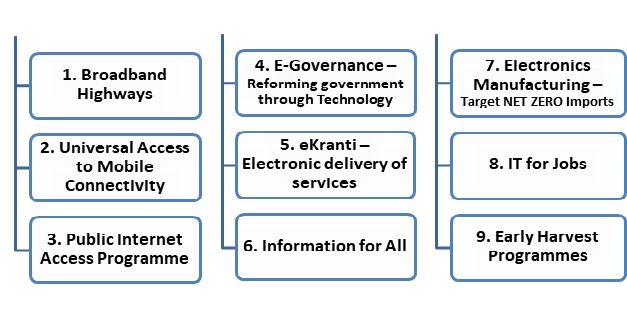
Figure 1: The nine pillars of the Digital India Programme
The first pillar on broadband highways aims at expanding high-speed connectivity to all 250,000 village panchayats in the country and ensuring high-speed internet access for all. It also aims at creating a National Information Infrastructure to provide cloud infrastructure and next generation network services to connect all government institutions and service delivery centres up to the village level.
The second pillar on universal access to mobile connectivity aims at expanding mobile connectivity across the entire length and breadth of the country by covering all the over 55,000 uncovered villages. The third pillar on public internet access programme aims at universalizing internet access through an expanded network of 2,50,000 common service centres, one in every panchayat. The 1,50,000 post offices are also proposed to be converted into multi-service centres.
The next two pillars on e-governance aim at holistic transformation of governance and delivery of public services through the use of ICT. Comprehensive government process reengineering (GPR) would be made mandatory in every domain before deployment of ICT to improve delivery of services. Use of common platforms such as online authentication through Aadhaar, Mobile Seva for mobile phone based delivery of services, Digital Locker for online storage and sharing of government issued documents, online and mobile payment gateway, adherence to uniform standards and guidelines across multiple applications and databases and single sign-on mechanism for seamless navigation and access to services across multiple government portals would be encouraged to ensure integration of services and their interoperability. The recently approved e-Kranti or the National e-Governance Plan (NeGP) 2.0 framework has expanded the number of Mission Mode Projects (MMPs) in e-governance from 31 to 44 and covers every possible domain providing citizen and business-centric services. This plan covers all central government departments and all states and Union Territories (UTs). To enable the implementation of these e-governance projects using common platforms and to ensure interoperability and integration of services, the Government of India has already approved a slew of policies that include policies on adoption of open source software, open Application Programming Interfaces (APIs), e-mail, use of IT resources, collaborative application development and application development and re-engineering guidelines. Ensuring cyber security is a vital part of the entire strategy. Futuristic technologies such as Internet of Things (IoT) would also be mainstreamed in the relevant sectors in future. Use of social media, mobile, cloud platform and analytics form the key components of the overall strategy.
The sixth pillar on information on all aims at facilitating open and easy access to information for all and pro-active engagement with citizens through social media. The government’s open data platform (data.gov.in) has the vision of sharing all publicly available government data through a single portal that can be used by the developer community to develop apps for various purposes. MyGov.in platform engages with citizens to obtain their inputs and ideas on various governance issues.
The seventh pillar on electronics manufacturing has set a very ambitious target of net zero imports in the electronics sector by 2020. It is estimated that the total size of the electronics sector in the country would be worth around US$ 400 billion by 2020. In the absence of any policy interventions, India would need to import almost US$ 300 billion worth of electronic goods and components by 2020. In order to encourage domestic manufacturing in this sector, a range of measures has been announced by the government. These include subsidies on investment and elimination of cost disadvantages through rationalization of the duty structure to promote domestic manufacturing. The focus areas in this sector are fabs, fab-less design, set top boxes, mobiles, consumer and medical electronics, smart energy meters, smart cards, etc. There is also a huge emphasis on producing highly skilled personnel in this sector through schemes such as scholarships for students for Ph.D. programmes at premier institutions.
The pillar on IT for jobs aims at training 1 crore youth from smaller towns and villages in the IT sector over the next five years. Business Process Outsourcing (BPO) enterprises would be set up in the north-eastern states to facilitate IT enabled growth in these areas. There is also emphasis on training at least 5 lakh rural workers by the telecom service providers (TSPs) to cater to their own needs in expanding access to telecommunication and broadband services in these areas.
The last pillar on early harvest programmes aims at early implementation of projects in selected areas so that benefits could be realized quickly. These include setting up an IT platform for messages to be sent to people, providing wi-fi facilities in universities, biometric attendance in offices, ensuring secure email infrastructure within government, providing public wi-fi hotspots, converting all school books to be e-Books, a national portal for lost and found children and an SMS based weather information and disaster alert system. Many of these initiatives have already been made operational. Digital India is a visionary programme that lays a solid foundation for a futuristic India driven by technology-led transformation. However, there is a need for concerted efforts by all the stakeholders to ensure that all the components of the programme are implemented holistically so that the intended benefits can be realized and the overall vision of the programme achieved.
(The above article originally appeared in ICT Connect, Magazine of ICT Academy of Tamil Nadu, March 2016, 6-8.
Transforming the Government Digitally: Challenges and Opportunities
India is witnessing a great digital transformation today in all spheres of economy and society. Digital technologies are being deployed by both the public and the private sectors to increase efficiencies, transform business processes and deliver greater value to their stakeholders. The government has launched the ambitious Digital India programme with the goal of transforming the government and the economy using digital technologies.
How are these digital technologies going to impact governance in the coming decade? How are the existing business processes and public service delivery models going to change? What are the challenges to such a transformation? In this article, I examine these aspects with specific reference to the advent of the latest technologies such as cloud, big data, analytics, social media, mobile, automation, Internet of Things (IoT), artificial intelligence (AI) and robotics. Some of these technologies are rapidly becoming mainstream and are significantly impacting the industry and the way applications are being developed and deployed in various domains.
Some of these new technologies are already being used by the government to make the delivery of public services more efficient and improve the government-citizen interaction. For example, the Mobile Seva project of the Government of India has significantly improved access to public services by bringing a large number of them on the mobile platform. The Digital India programme has also made cloud as the platform of choice for many departments for efficient use of computing resources and quick deployment of applications. The government is also using social media effectively to communicate with the citizens and other stakeholders. MyGov.in platform is being used by many departments to solicit views of all stakeholders on various government programmes.
Can the other emerging technologies such as big data, analytics, automation, IoT, AI and robotics impact governance? The potential of these technologies to transform business models and bring new products and services is enormous. Industries in several sectors have already started using these technologies to increase efficiency, reduce costs and improve their customers’ experiences. For example, automation of repetitive and rule based tasks is causing a significant disruption in the information technology (IT) services industry causing fears of layoffs. Government processes can be reengineered to take advantage of automation to make the delivery of services more efficient and accessible. Similarly, robots can also be used to improve citizen interaction when people visit government offices for seeking information or availing services.
Big data and analytics are being used by a number of industries to generate new insights into consumer behavior and offer customized services. Government departments can also effectively use these technologies to analyze patterns in citizen demand for various services and tailor delivery mechanisms accordingly. Big data and analytics can also help the government in transitioning to a data driven and evidence-based policy environment to improve the quality of outcomes.
Internet of Things has the potential to lead to a truly connected world and enable real time responses to various events and situations. Missions such as smart cities can very effectively exploit IoT to deliver a truly seamless and connected urban infrastructure and improve the living experiences of citizens.
What are the enablers to such digital transformation of the government in future? There are four critical factors that can help the government in fully exploiting the emerging technologies to become more efficient and dramatically improve the quality of governance and delivery of services to citizens and businesses. First, the government must have a clear and long-term digital strategy aimed at taking full advantage of the potential of these technologies. The digital strategy must aim at end-to-end transformation of the entire business processes and not just the service delivery interface.
Secondly, leadership is critical to such a digital transformation of the government. Presence of leaders capable of understanding the full implications of the emerging technologies of the future and driving change within the organizations accordingly to transform business processes and public interface is extremely important. In India, this would require massive capacity building efforts at senior management levels across the government to prepare the leaders adequately. Government should also involve capable leaders from the private sector to drive this transformation.
Thirdly, achieving a government wide transformation would require massive capacity building and skilling of the government workforce. Presently, these capabilities are singularly lacking in government organizations despite recent efforts in this direction. Capacity building is required at all levels across the entire government and not just in the specialized units dealing with computerization.
Next, the government would also need to ensure that appropriate applications using the emerging technologies are developed and deployed effectively and used across various domains to derive the desired outcomes. This would entail creating and sustaining an organization wide digital culture and focus on change management to ensure that the entire organization is committed to digitally driven transformation.
Finally, such a massive programme would need the holistic involvement of all the stakeholders, in particular the citizens and businesses and the industry partners to succeed. The citizens and businesses, who are the primary beneficiaries, would need to enhance their digital literacy to take full advantage of a government wide digital transformation. The efforts being undertaken to make the citizens digitally literate under the Digital India programme augur well for such an endeavour in future.
What are the challenges that the government might face in making this transformation a reality? The key challenges include developing leadership and building workforce skills, finding adequate financial resources, addressing security concerns and developing a digital culture within the organization and amongst the stakeholders. The government would also need to put in place a suitable legal framework to drive the digital transformation. These challenges need to be adequately addressed to make this entire endeavour a success. The emerging technologies present a great opportunity for us to transform our governance digitally to make all services truly online, end-to-end, connected and integrated in the next decade. We must overcome the challenges in achieving this vision through strategic planning, devoting adequate resources, building capabilities at all levels, developing and deploying appropriate applications and involving all the stakeholders. We are the world leaders in IT and it is the right time that we take the lead to use these technologies for transforming the quality of governance in the country.
(The above article was originally published in the eGov Magazine in its July 2017 issue. It is available at: https://egov.eletsonline.com/2017/08/transforming-the-government-digitally-challenges-and-opportunities/).
Digital India: What Next?
A flurry of projects is being launched under the Digital India programme on a regular basis. Some of the major projects include the digital payments app BHIM, Government e-Market (GeM), Aadhaar linked e-Sign and digital locker, Mobile Seva, MyGov, Bharat Net, National Scholarship Portal and e-Hospital. Digital India is a very ambitious programme aimed at transforming India into a digitally empowered economy and knowledge society. It was approved in August 2014 with great expectations to usher the country in a new era of digitally driven growth and prosperity. How has the programme performed in its nearly three years of implementation and what lies next for it? What mid-course corrections, if any, can be made to enable it to achieve its desired outcomes in the future?
Digital India is centered on three key vision areas. The first element of the vision is to provide digital infrastructure to every citizen and create access points for delivering digital services. The second vision area focuses on providing access to government services on demand. The third vision area focuses on capacity building and empowering citizens so that they can become active participants in a digitally driven economy. The programme covers nine pillars of growth areas which include broadband highways, universal access to mobile connectivity, public Internet access programme, reforming government through technology, electronic delivery of services, information for all, IT for jobs, electronics manufacturing and early harvest projects.
The achievements under the programme have been noteworthy though the full impacts of the projects are yet to be realized. Under the Bharat Net project, optical fibre connectivity has reached over 75,000 panchayats, covering about 30% of all the panchayats. Government data centres and wide area networks have been established in almost all the states. Over 3 lakh common service centres (CSCs) to deliver government and business services have been established across the country. These CSCs cover over 1.72 lakh panchayats. The government has keenly pushed JAM (Jan Dhan, Aaadhaar and Mobile) to ensure financial inclusion. Aadhaar enrolment has crossed 112 crores while the Direct Benefit Transfer (DBT) has shown promising results in schemes like scholarships, PAHAL, public distribution system, MGNREGS and the National Social Assistance Programme. The Mobile Seva project has brought about a transformation in delivering government services through mobiles. Both Digital Locker and the MyGov platforms have over 40 lakh registered users.
Though the projects under Digital India have made a good beginning, it is clear that they are yet to achieve their desired outcomes considering the large population (especially in rural areas) and geographical expanse of the country. How can the programme achieve its full impact within the targeted timeframe? It must be realized that the penetration of e-governance services is still low in the country due to lack of ICT infrastructure and low digital literacy. Lack of local language support is also an important barrier. Further, the full potential of the mobile platform for delivering government services has not been realized and new technologies for enhancing the effectiveness of the applications, such as data analytics, Internet of Things and GIS, have not been exploited fully. The performance has also varied significantly across the states.
What can be done to enhance the effectiveness of the projects under Digital India? We must aim at enhancing the reach and impact of the projects with focus on rural areas and economically weaker sections. For this, the projects must aim at increasing both their scale and scope. While the scale involves enhancing both geographic reach and number of transactions, scope implies that the applications be made end-to-end involving completely paperless, faceless and cashless transactions. Mobile must be made the default access mode for applications to enhance reach and coverage and local language interfaces must be seamlessly integrated. The digital locker ecosystem must be expanded and large scale digitization of records initiated to make all transactions paperless. Similarly, for making all transactions faceless and cashless, Aadhaar should be made the primary mode of authentication and payments. The network of CSCs must be increased to cover every panchayat. We also need to focus on cybersecurity to ensure that our electronic infrastructure and transactions are safe and secured. Institutionally, all states and union territories must be brought on board as key stakeholders in implementation.
To truly enhance the reach of Digital India, we must develop digital villages and digital markets. A digital village would focus on connectivity and applications to provide services digitally in villages, such as tele-health, virtual classrooms and skilling and capacity building. A digital market would help in integrating the rural economy at regional and national levels and bring better remuneration to farmers and artisans.
Ensuring that every citizen is able to benefit from Digital India would require massive efforts at capacity building, especially in the rural areas and amongst women. Government and private organizations also need to enhance their capacities manifold at all levels to deliver their services digitally.
Digital India is transformational in its vision. However, we need to ensure that it reaches each and every Indian to truly achieve this vision.
 Ideas That Make You Think And Do