
Securing 15000 kilometres: Why the future of India’s borders lies in data, drones and digital surveillance

Smart Borders: Conecept image generated using AI

Effective border security and management around the world today is a complex and multi-dimensional challenge that requires carefully balancing national security against the need for facilitating legitimate trade and travel. Global trends show a shift from purely physical barriers to “smart borders”, integrating advanced technology to counter sophisticated threats, including illegal infiltration, smuggling and terrorism.

India’s land borders, at over 15,000 kms, are amongst the longest in the world. While the Indo-Pak and Indo-Bangladesh borders are physically fenced, other borders are unfenced and remain more vulnerable to illegal infiltration, smuggling, etc. India faces multifarious challenges in border security and management, which include cross-border terrorism, illegal infiltration, drugs and arms smuggling, undemarcated borders, and territorial disputes with some of its neighbours.

First, porous borders and difficult terrain, including dense forests along the Mynamar border, high mountains on the China and Pakistan borders and riverine areas along the Bangladesh border, make 24×7 surveillance difficult and challenging.

Secondly, our western border with Pakistan faces constant attempts at infiltration and cross-border terrorism. Illegal infiltration and cattle smuggling are major challenges along the Indo-Bangladesh border.

Thirdly, drug smuggling through the porous borders remains a major challenge. Smuggling of drugs through drones flying from across the borders have also been reported in recent times.

Fourthly, unresolved border disputes with China have resulted in frequent military standoffs. Infrastructural deficiencies along the border, such as incomplete fencing, lack of all-weather roads and outdated surveillance tools may also hinder quick response times.

To address the challenges noted above, the best practices worldwide are evolving towards a “whole-of-government” and technology-based solutions to create “smart borders”. Border management today needs to go beyond physical infrastructure to integrate terrain, technology, and intelligence. On our borders, physical assets need to be combined with AI-enabled digital surveillance, data analytics, space-based assets, and real-time intelligence fusion to create integrated security systems. Intelligence, Surveillance and Reconnaissance (ISR) capabilities need to be strengthened through AI cameras, smart fencing sensors, Unmanned Aerial Vehicle (UAV) imageries, predictive analytics on legacy data, and GIS/ERP integration, enabling continuous detection, analysis, and response. Integrated Command and Control Centres with unified intelligent dashboards can enable this ecosystem to operate effectively. These systems would require very robust cybersecurity protocols to be put in place to protect the digital assets.

At the integrated check posts and authorised border crossing points, biometric identification can be implemented to prevent fraud. For cargo, full body truck scanners can be installed to detect any hidden contraband, arms, etc.

Secondly, institutional and strategic approaches are also important for ensuring integrated border management. These would involve focusing on interdepartmental cooperation and coordination amongst customs, immigration, border guarding forces and state government agencies to break functional silos and ensure real-time sharing of information and coordinated responses. International cooperation with the neighbouring countries for sharing intelligence and coordinating responses to any activities on the ground would also be helpful. However, this may not be always feasible with hostile neighbours. Involving the local border communities for creating a human intelligence network can also prove very useful in sourcing intelligence.

Thirdly, creating modern border infrastructure is extremely important for securing our borders. Both lateral and axial roads in the border areas, especially along the Indo-China border, need to be developed at a rapid pace to allow for easier movement and quick response by our border guarding forces. Recently approved schemes for building lateral and axial roads along the border in Punjab and Rajasthan and along the Indo-China border aim at addressing this infrastructure deficit along our borders.

Last, but not the least, developing the border villages is critical for border security. The Vibrant Villages Programme, now operational in all the bordering states and UTs, aims at improving village level infrastructure, connectivity and enhancing economic opportunities to reduce local susceptibility to criminal influence. It has already made an impact in the remote villages along the Indo-China border by reversing outmigration of the local population. In future, border management needs to shift from reactive border control to proactive and dynamic situational awareness, aligned with evolving threats and broader national security and resilience objectives. The greatest impact is expected from AI-enabled predictive and prescriptive threat assessment, integrated surveillance across land, sea, air, space, and cyber domains, AI-assisted logistics and personnel deployment, and the use of AI-enabled robotics. We need to take advantage of this rapidly evolving technological landscape to secure our borders.

(The above article appeared in The Economic Times on June 18, 2026 and is available at: https://government.economictimes.indiatimes.com/blog/revolutionizing-indias-border-security-the-role-of-data-and-technology/131815508. The views are personal.)

AI Surveillance Useful In Monitoring Challenging Terrain, Detecting Real-Time Threats: Rajendra Kumar

Secretary (border management) says to be effective in securing and managing borders, stakeholders need to synergise efforts through tech-intensive surveillance.

Source: https://www.etvbharat.com/en/bharat/ai-surveillance-useful-in-monitoring-challenging-terrain-detecting-real-time-threats-rajendra-kumar-enn26021903615

By ETV Bharat English Team

Published : February 19, 2026 at 3:46 PM IST

By Gautam Debroy

New Delhi: Stating that Artificial Intelligence (AI) can play an important role in transforming border management by enhancing and strengthening India’s ISR (Intelligence, Surveillance and Reconnaissance) ecosystem, Rajendra Kumar, Secretary (Border Management), said on Thursday that technologies like AI-powered surveillance sensors, drones, etc. can be very useful in monitoring challenging terrain and detecting threats in real time.

“AI can also play an important role in resource optimisation and optimal deployment of our border guarding forces for effective management of border areas. By enabling faster, data-driven decisions, AI can significantly improve efficiency in managing complex border security challenges,” he said, in an exclusive interview with ETV Bharat.

When asked whether AI has been used in border management, Kumar said, “As these technologies are constantly evolving, various stakeholders managing the borders would need to synergise their efforts through tech-intensive surveillance to be effective in securing and managing our borders. The use cases for deploying AI in border management are also constantly evolving.”

AI For Defence

Kumar said AI can act as a critical force multiplier in national defence, by accelerating decision-making, enhancing surveillance, and optimising logistics.

“AI-powered systems can analyse vast amounts of satellite, drone, and sensor data, to detect border intrusions and identify threats in real time. In cybersecurity, AI can identify and mitigate threats faster than humans, securing critical infrastructure. AI can drive unmanned autonomous vehicles (UAVs) and robotic systems for high-risk reconnaissance, protecting personnel,” he said.

According to Kumar, AI can also enable predictive maintenance of military equipment, ensuring operational readiness. “Ultimately, AI increases battlefield intelligence, agility, and efficiency,” he said.

Improve Governance, Services, Last-Mile Delivery

The border management secretary also said that AI can improve governance, delivery of citizen-centric services and last mile delivery, by automating administrative tasks, using predictive analytics for data-driven policymaking and fostering transparency.

“Citizen-centric services can be improved via multilingual AI chatbots, personalised services in various domains like health and education, and faster, automated grievance redressal. For this, the government needs to develop a full AI stack, comprising AI compute infrastructure and models, which will enable various ministries and departments to quickly develop and deploy their own applications for various use cases. Together, these innovations can enhance public service delivery, making it more efficient and inclusive,” he said.

AI Summit A Showcase Of Whole-Of-Nation Approach

“I think hosting the India AI Impact Summit 2026 is a major achievement for the country, which will enhance its global leadership in digital and emerging technologies. It helps in bringing the focus sharply on ‘AI for Development’ and in prioritising tangible, population-scale solutions using AI,” said Kumar.

He said the summit showcases our unique “whole-of-nation” approach towards the development and deployment of AI, utilising Digital Public Infrastructure (DPI) to democratise technology and ensure equity in access.

“This initiative also helps bridge the global AI divide, showcasing how AI can drive sustainable growth and empower underserved communities,” Kumar said.

India A Leading AI User & Creator

According to Kumar, India is rapidly emerging as a leading AI user and creator, focusing on a ‘bottom-up’ approach through population-scale applications and DPI. “Ranked among the top three nations in the world in AI competitiveness, India is leveraging its massive talent pool and a rapidly growing start-up ecosystem, with over 30,000 AI-focused start-ups to drive innovation at scale. Its light-touch regulatory approach, combined with its rich and diverse data, positions it as a critical and unique player in the global AI landscape,” said Kumar.

To further develop India’s AI ecosystem, Kumar said we need to focus on boosting our sovereign AI capabilities and build localised, multilingual AI-driven solutions in diverse domains, such as healthcare, education, agriculture, logistics, etc.

(The above interview was published on February 19, 2026 on ETV Bharat. It is available at: https://www.etvbharat.com/en/bharat/ai-surveillance-useful-in-monitoring-challenging-terrain-detecting-real-time-threats-rajendra-kumar-enn26021903615)

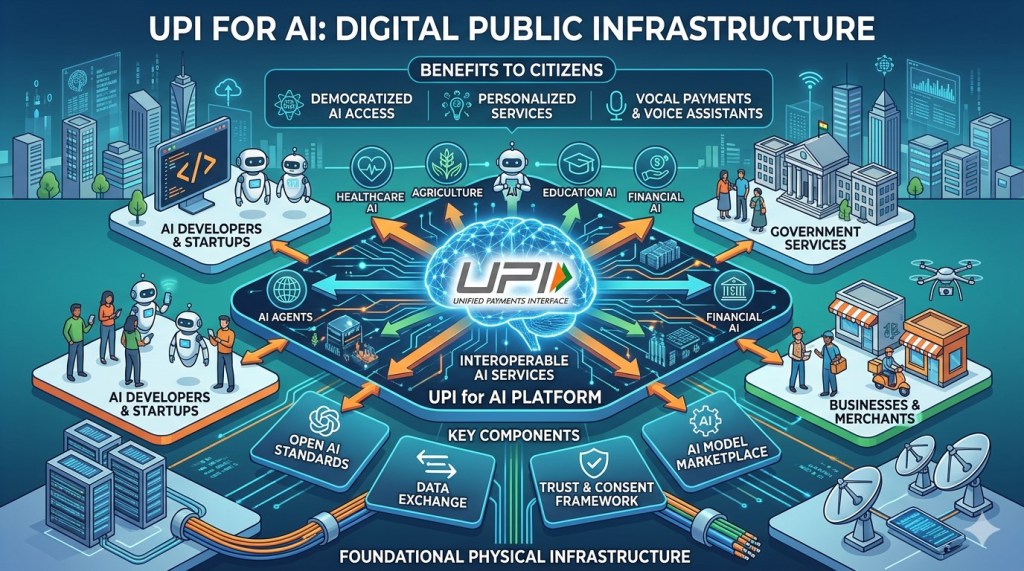
Create a “UPI for AI” as a Digital Public Infrastructure

Source of image: Generated by the author using AI

Artificial Intelligence (AI) technology is advancing rapidly and the AI models are becoming more and more complex and capable. This is being driven by increasing computational resources, massive data availability and record investments being made in developing ever larger large language models (LLMs) with hundreds of billions of parameters. However, many of the most prominent LLMs are proprietary or closed-source, which may pose significant barriers in their usage by small businesses and start-ups due to the high costs involved in their subscription. There are also a large number of open-source AI models available, including many small language models fine-tuned for specific domains or use cases, which can be used freely by anyone. However, these models have their own individual Application Programming Interfaces (APIs) and protocols that may require separate integrations for each model in various applications. This model fragmentation makes the entire process quite cumbersome and inefficient for developers developing applications for various use cases and users trying to seamlessly switch between models to discover the best one suited for their specific requirements.

Can a unified interface like that of UPI be developed for open-source AI models for easier access, interoperability and discoverability? Developing such a unified interface as a Digital Public Infrastructure (DPI) can address these concerns. The key factors for success of UPI lie in its open architecture, interoperability, and instant real-time transactions through Virtual Payment Addresses (VPAs) or mobile numbers. This creates a level playing field for various payment apps and services. Similarly, an open network of AI models would allow developers to swap between different models from different providers through a Unified Model API without rewriting their application’s core logic. Each model can be provided a Virtual Model Address like that of VPAs in UPI for routing the request to the correct model. Such an architecture would also allow for seamless interoperability between models from different providers based on accuracy, speed or specific domain requirements.   

Such a Unified Interface (UI) for AI platform requires several steps for implementation. First, standardization is required to address the issue of API fragmentation in the AI ecosystem. This would involve defining compliant APIs, model data and Input-Output (IO) formats, and a virtual address system for each model. A universal standard would also require broad industry buy-in, which can be addressed through a combination of policy measures and engagement with the industry.

Secondly, a central routing and arbitration layer incorporating a central public registry of AI models would need to be created for intelligent routing of user’s requests to the best-suited model based on performance, costs or domain specific requirements. This central routing layer would also ensure interoperability.

Thirdly, a governance and regulatory compliance layer would need to be created to ensure fair access, maintain security and prevent misuse. This would involve defining security standards for authentication, data privacy and encryption to protect sensitive data shared with the AI models. It would also require a compliance framework to be put in place with clear rules to address AI bias, transparency and accountability. A dispute resolution mechanism would also need to be established.

Last, but not the least, a systematic drive for adoption of the UI for AI would need to be undertaken to ensure that all the model providers are onboarded through a broad consensus for uniform API standards. Continued engagement with them would also be required to keep the ecosystem robust and secure. Start-ups and application developers can be provided with incentives to build applications on top of the unified interface. Government ministries and departments can train specific AI models using their own domain datasets and undertake large-scale development of AI-driven applications for their use cases using this unified AI interface. This would drastically cut down the time required for developing and going-live with their applications.

The concept of a “UPI for AI” as a digital public infrastructure is both feasible and desirable and needs to be actively pursued to simplify model access and enhance interoperability. This would also encourage innovations in AI technologies, model training and their deployment in a large number of use cases. For maximum impact and accessibility, such an endeavour needs to be undertaken by the government through its IndiaAI Mission. This would also help in ensuring security, data privacy and regulatory compliances.

(The above article appeared on October 30, 2025 in The Economic Times online. It is available at: https://economictimes.indiatimes.com/tech/artificial-intelligence/create-a-upi-for-ai-as-a-digital-public-infrastructure/articleshow/124943526.cms?from=mdr)

(The author is a senior IAS officer and currently the Secretary, Department of Border Management, Government of India. The views are personal.)

Transforming Governance with a Unified AI Stack

Source: Generated through AI by the author

With rapid advancements in artificial intelligence (AI), organisations are scrambling to implement the technology in their business processes and service delivery frameworks to improve efficiency and enhance citizen experiences.

AI is set to impact nearly every sector, but to harness its potential, organisations need an ‘AI-first’ strategy that includes scalable, flexible AI solutions for business transformation. This requires an integrated AI stack — comprising infrastructure, data, AI models, and applications — enabling AI deployment across various use cases. Can such an AI stack be developed as a digital public infrastructure (DPI) by the government to provide seamless, proactive services to citizens and businesses?

To create a DPI, it is essential to understand the components of an enterprise-level AI stack. The foundation of this stack is a compute infrastructure layer, which includes compute capacity, storage, networking and tools for developing, training and deploying AI models. This layer would utilise Graphics Processing Units (TPUs), Central Processing Units (CPUs) and Tensor Processing Units (TPUs) optimised for AI workloads. Cloud platforms offer scalability, while edge computing may be necessary for real-time services in remote or low-bandwidth environments.

The second layer consists of the data layer, which focuses on collecting, storing, cleaning and annotating data for use by the AI models. Data security and compliance with the privacy laws must be ensured through encryption, anonymisation and access control. Data comes from various sources like structured and unstructured databases, web, Internet of Things (IoT), Application Programming Interfaces (APIs), etc. It must be cleaned and prepared for the AI model training to enhance accuracy and fairness. Ministries and departments have created huge databases under the Digital India programme that can be shared to train AI models for delivering predictive and proactive services to citizens and businesses.

The next layer is the model development layer, which focuses on designing and training models on the processed data from the data layer to address specific use cases, such as text or image/video generation, predictive analytics, etc. This involves selecting suitable AI frameworks, libraries, algorithms for the type of AI tasks involved, their optimisation and validation. Many open-source options, including pre-trained foundational models, can be customised for specific domains. However, developing indigenous foundational models is crucial to ensuring strategic autonomy and creating world-class capabilities within the Indian technology ecosystem. This doesn’t need to be resource-intensive, as demonstrated by DeepSeek.

The developed AI model is then deployed or exposed through APIs or microservices enabling integration with the enterprise systems, web and mobile applications. Next comes the application layer, which integrates AI models into real-world systems to deliver AI-enhanced products and services. This may involve reengineering business processes, automating tasks and redesigning user interfaces. For example, an AI application for predictive analytics might generate advance warnings for heavy traffic at specific locations during peak hours and send automated alerts for immediate action.

Finally, the AI stack also needs to have a governance layer to ensure that the associated risks, if any, are managed and trust is built in the AI systems. The government’s IndiaAI Mission should focus on creating a common AI stack as DPI, which all ministries and departments can use to build their own AI applications. This will prevent duplication of efforts and resources and create a vibrant innovation ecosystem focused on transforming public services with an ‘AI-First’ strategy. The AI stack could also be made available to startups and the private industry to promote collaborative development and deployment of AI applications.

(The above article appeared in The Economic Times on February 9, 2025. It is available at https://economictimes.indiatimes.com/tech/artificial-intelligence/transforming-governance-with-a-unified-ai-stack/articleshow/118073623.cms?from=mdr. The views expressed are personal.)

Transforming Governance through AI

Source of the image: Generated through AI by the author

Artificial intelligence (AI) technologies have the potential to transform governance and bring about a paradigm shift in citizen-centric delivery of services. Imagine a student applying for college admissions. Instead of separately applying for numerous universities and colleges with the need for filling multiple applications with repetitive data each time, an AI-driven system would proactively collate the basic demographic information about the student and suggest the probable list of colleges based on his/her score in the qualifying examination. It would even fill out a common application form for admission to various institutions and automatically apply for various scholarships for which the student might be eligible based on demographic and income criteria. At the other end, the selection and allotment of seats by the universities and colleges would become much easier and faster with the AI-driven system seamlessly sorting the preferences, allocating seats and awarding eligible scholarships to each student. The above system can easily be operated at the state and national levels. The resultant savings in time, cost and efforts for all the stakeholders would be enormous.

The above vision of an AI-driven and proactive governance can easily be replicated in many other domains, e.g., health care, agriculture, crime detection and prevention, cyber security, etc. In health care, AI can help in much faster diagnosis and detection of diseases through analysis of scans, etc. enabling better treatment, remote care, and substantial savings in time and cost for the patients and hospitals. Similarly, predictive data analytics can provide deep insights into patterns of crime and suggest more effective prevention strategies through proactive policing. AI algorithms can analyse traffic flow patterns and suggest better route planning and optimization to reduce congestion. AI-enabled chatbots can provide very specific and contextualized responses in multiple languages to queries from citizens and even deliver a wide range of citizen-centric services, e.g., access to various certificates, education and medical records, etc. They can become invaluable tools in information dissemination and driving citizen engagement.

AI can also enable transformation of the government itself through smarter policy formulation driven by predictive analytics and evidence-based decision making. It can help in formulating proactive strategies and implementing an agile framework for governance.

As outlined above, AI-driven governance can herald a new era of transformation, innovation and efficiency. However, to achieve this vision, the government must take a number of enabling policy initiatives.

First, it must ensure that there are adequate investments in AI focused compute infrastructure and R&D by both the public and private sectors to fuel innovation and development of new applications. Government driven investments in AI infrastructure and R&D will also help in creating a vibrant startup ecosystem in India that can focus on developing AI based applications in various domains.

Second, the government must evolve and put in place a regulatory framework for AI that encourages innovation while at the same time recognizing and mitigating the risks that may be associated with the development and implementation of AI technologies and applications.

Third, the government must enable access to large amounts of anonymized domain datasets which the concerned central ministries and states have built in the course of implementing a very large number of e-governance projects over the past few decades. This will enable the industry and startups to develop and train innovative AI applications for various domains.  

Fourth, the industry must focus on ethical development and deployment of AI applications. This would ensure transparency and accountability in the entire process allowing for identification and mitigation of any biases and promotion of fairness and trust amongst all the stakeholders including the end-users.

Fifth, privacy preserving technologies and stringent data security protocols must be followed in the development and deployment of AI applications. This will help in mitigating any risks of data breaches and cyber frauds. It is also essential that all precautions to ensure cybersecurity in the entire infrastructure and application ecosystem are taken.

Last but not least, skilling for AI to meet the burgeoning needs of the industry is of paramount importance. Our best technical institutions must focus on advanced education and R&D while the industry can focus on targeted training programmes in niche areas to build adequate human resource capacity in AI. While India is a global leader in information technology services, when it comes to government readiness for AI, a recent report by Oxford Insights ranks India at the 40th position out of 193 nations. For making India a global leader in AI, it is the right time to focus on AI-driven governance for transforming the government and reimagining public service delivery.

(The above article appeared in The Economic Times on 28th June, 2024. It is available here: https://economictimes.indiatimes.com/tech/artificial-intelligence/transforming-governance-through-ai/articleshow/111543404.cms?from=mdr. The views are personal.)