
The next wave of digitization needs to ensure that digital opportunities should ..
Tag: ICT4D
Foundation for a Future India: Digital India
India today ranks amongst the largest economies of the world and has become the fastest growing large economy. However, it is still a lower middle income country in terms of per capita income with substantially high levels of poverty and deprivation and significant regional imbalances in development. The vision of a future India must aim at holistic development in all sectors of the economy and society so that overall human development and quality of life is improved in the country.
Can technology led transformation lay the foundation of a future India? In this article, I examine this central question with reference to the recently launched Digital India programme of the Government of India that aims at transforming the country into a digitally empowered society and knowledge economy. The programme weaves together a large number of ideas and thoughts into a single, comprehensive vision so that each of them is seen as part of a larger goal. The focus of Digital India is on being transformative – to realize IT (Indian Talent) + IT (Information Technology) = IT (India Tomorrow) and on making technology central to enabling change.
This futuristic vision of the programme is centred on three key areas, namely, digital infrastructure as a utility to every citizen, governance and services on demand and digital empowerment of citizens. The idea is to transform the entire ecosystem of public services through the use of information and communication technologies (ICT) and build holistic capabilities across a wide range of sectors, e.g., ICT infrastructure, e-governance, software services and delivery platforms, electronics manufacturing, Internet of Things (IoT), IT skills and job creation, etc. The focus is on making ICT as a key driver for transforming every sector of the economy and society. In order to achieve this futuristic vision for a developed India, Digital India focuses on several key developmental strategies. These include promoting investments through improving ‘ease of doing business’, encouraging entrepreneurship across various sectors through leveraging IT, capacity building and creation of jobs in the IT sector, providing easy access to public services anytime from anywhere, promoting financial inclusion through mobile banking and micro ATMs, promoting literacy through e-books and other digital contents, faster services and dissemination of information to promote growth in diverse sectors such as agriculture, education and healthcare, and encouraging more participation from women in various sectors of the economy and society.
In order to lay the foundation for future India, Digital India has identified nine key pillars of growth areas. These include broadband highways, universal access to mobile connectivity, public internet access programme, reforming government through technology, electronic delivery of services, information for all, electronics manufacturing, IT for jobs and early harvest programmes. The pillars provide a number of specific targets and activities within those growth areas so that the concerned sectors can benefit from IT enablement. The figure 1 below depicts the nine pillars of the programme.
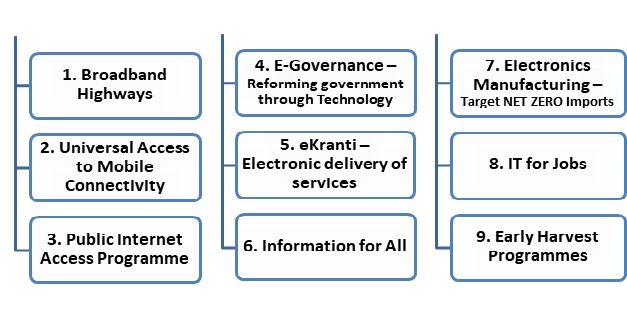
Figure 1: The nine pillars of the Digital India Programme
The first pillar on broadband highways aims at expanding high-speed connectivity to all 250,000 village panchayats in the country and ensuring high-speed internet access for all. It also aims at creating a National Information Infrastructure to provide cloud infrastructure and next generation network services to connect all government institutions and service delivery centres up to the village level.
The second pillar on universal access to mobile connectivity aims at expanding mobile connectivity across the entire length and breadth of the country by covering all the over 55,000 uncovered villages. The third pillar on public internet access programme aims at universalizing internet access through an expanded network of 2,50,000 common service centres, one in every panchayat. The 1,50,000 post offices are also proposed to be converted into multi-service centres.
The next two pillars on e-governance aim at holistic transformation of governance and delivery of public services through the use of ICT. Comprehensive government process reengineering (GPR) would be made mandatory in every domain before deployment of ICT to improve delivery of services. Use of common platforms such as online authentication through Aadhaar, Mobile Seva for mobile phone based delivery of services, Digital Locker for online storage and sharing of government issued documents, online and mobile payment gateway, adherence to uniform standards and guidelines across multiple applications and databases and single sign-on mechanism for seamless navigation and access to services across multiple government portals would be encouraged to ensure integration of services and their interoperability. The recently approved e-Kranti or the National e-Governance Plan (NeGP) 2.0 framework has expanded the number of Mission Mode Projects (MMPs) in e-governance from 31 to 44 and covers every possible domain providing citizen and business-centric services. This plan covers all central government departments and all states and Union Territories (UTs). To enable the implementation of these e-governance projects using common platforms and to ensure interoperability and integration of services, the Government of India has already approved a slew of policies that include policies on adoption of open source software, open Application Programming Interfaces (APIs), e-mail, use of IT resources, collaborative application development and application development and re-engineering guidelines. Ensuring cyber security is a vital part of the entire strategy. Futuristic technologies such as Internet of Things (IoT) would also be mainstreamed in the relevant sectors in future. Use of social media, mobile, cloud platform and analytics form the key components of the overall strategy.
The sixth pillar on information on all aims at facilitating open and easy access to information for all and pro-active engagement with citizens through social media. The government’s open data platform (data.gov.in) has the vision of sharing all publicly available government data through a single portal that can be used by the developer community to develop apps for various purposes. MyGov.in platform engages with citizens to obtain their inputs and ideas on various governance issues.
The seventh pillar on electronics manufacturing has set a very ambitious target of net zero imports in the electronics sector by 2020. It is estimated that the total size of the electronics sector in the country would be worth around US$ 400 billion by 2020. In the absence of any policy interventions, India would need to import almost US$ 300 billion worth of electronic goods and components by 2020. In order to encourage domestic manufacturing in this sector, a range of measures has been announced by the government. These include subsidies on investment and elimination of cost disadvantages through rationalization of the duty structure to promote domestic manufacturing. The focus areas in this sector are fabs, fab-less design, set top boxes, mobiles, consumer and medical electronics, smart energy meters, smart cards, etc. There is also a huge emphasis on producing highly skilled personnel in this sector through schemes such as scholarships for students for Ph.D. programmes at premier institutions.
The pillar on IT for jobs aims at training 1 crore youth from smaller towns and villages in the IT sector over the next five years. Business Process Outsourcing (BPO) enterprises would be set up in the north-eastern states to facilitate IT enabled growth in these areas. There is also emphasis on training at least 5 lakh rural workers by the telecom service providers (TSPs) to cater to their own needs in expanding access to telecommunication and broadband services in these areas.
The last pillar on early harvest programmes aims at early implementation of projects in selected areas so that benefits could be realized quickly. These include setting up an IT platform for messages to be sent to people, providing wi-fi facilities in universities, biometric attendance in offices, ensuring secure email infrastructure within government, providing public wi-fi hotspots, converting all school books to be e-Books, a national portal for lost and found children and an SMS based weather information and disaster alert system. Many of these initiatives have already been made operational. Digital India is a visionary programme that lays a solid foundation for a futuristic India driven by technology-led transformation. However, there is a need for concerted efforts by all the stakeholders to ensure that all the components of the programme are implemented holistically so that the intended benefits can be realized and the overall vision of the programme achieved.
(The above article originally appeared in ICT Connect, Magazine of ICT Academy of Tamil Nadu, March 2016, 6-8.
Sustaining Digital India: Converting Hype Into Reality
The Digital India programme has created a lot of expectations both within and outside the country. The high profile launch of the programme in July 2015 and the subsequent pronouncements by the prime minister have given rise to high expectations that India will embrace a path of technology led transformation across all sectors of the economy and society.
How can these expectations be realized and sustained and the vision of Digital India achieved? It is important to understand that Digital India cuts across all sectors of governance, economy and society and is, therefore, very vast in its scope and objectives. Its vision is centred on three key areas: digital infrastructure for every citizen, providing governance and services on demand and digital empowerment of citizens. The programme broadly covers nine pillars of key thrust areas, namely, broadband highways, universal access to mobile connectivity, public internet access programme, e-governance – reforming governance through technology, e-Kranti – electronic delivery of services, information for all, electronic manufacturing, IT for jobs and early harvest programmes. Each of these pillars requires massive and sustained efforts to ensure that the desired objectives are met.
A massive thrust to create digital and connectivity infrastructure reaching up to the village level is required to achieve universal access to digital services and bridge the digital divide. Access to broadband connectivity at village level would ensure that transformation through increasing digitalization in various domains can really benefit the entire population. Universal access to mobile connectivity can make last mile connectivity and mobile broadband affordable for the masses. Implementation of the BharatNet project and the rollout of 3G and 4G connectivity across the country must be speeded up to achieve these objectives.
The public internet access programme is aimed at universalizing access to common service centres. While increasing the number of such centres to cover every panchayat is important, it must be kept in mind that the bouquet of services being offered through these centres needs to be enlarged and made affordable. For example, education and skill development courses can be delivered through these centres in partnership with the private sector to benefit the rural youth and make these centres financially sustainable.
The two pillars on e-governance, namely, reforming government through technology and electronic delivery of services, require cross-sectoral and whole-of-government initiatives to really transform governance through technology. Common platforms like Aadhaar for de-duplication and online authentication, Mobile Seva for mobile phone based delivery of services, digital locker for online storage and sharing of government issued documents, and e-Sign for Aadhaar based online digital signature are laudable initiatives in this direction. However, massive efforts are required to ensure that these platforms are adopted by all departments both at the central and state levels to make the electronic delivery of services more efficient and avoid any duplication. The services of various departments must also be integrated at the backend using these common processes and platforms to ensure that the citizens are not required to visit multiple portals and fill multiple forms with similar information to avail various services. Single sign-on mechanism must also be made mandatory for various portals to make the life of netizens easier. These initiatives would also transform the currently available services for businesses and help in improving the ease of doing business in the country.
The pillar on information for all aims at providing all information online and use of social media for interaction with the citizens. This requires much greater transparency and openness on the part of the government departments and use of tools like open data platform and social media to allow much greater participation of citizens in governance. Initiatives like data.gov.in and MyGov.in are steps in the right direction. However, very few states are using these platforms. All states must adopt them to really have an impact on governance at the cutting edge.
Domestic electronic manufacturing is a key pillar of Digital India. The target under this pillar is to achieve net zero imports in electronic hardware by 2020. Recently, a number of incentives have been announced by the government to encourage domestic manufacturing in electronics. Duty structure on electronic components has also been rationalized to incentivize domestic manufacturing. However, the country is yet to see major investments in this area. Developing a localized ecosystem for domestic electronic manufacturing is a must to sustain the momentum.
IT for jobs is a very important pillar of Digital India that aims at skill development of the youth and digital empowerment of citizens. Coordinated efforts are required in this domain along with the various skill development programs being run by other ministries to achieve the objective of universal digital empowerment. Participation of the private sector would be crucial to ensure quality content and sustainable delivery.
Digital India is a visionary programme with a huge potential for technology led transformation of the country. However, sustaining the programme and achieving its vision require concerted efforts by all the stakeholders including the central government, all the states and the private sector.
(The author is a senior IAS officer with the Government of Tamil Nadu. He has led the conceptualization and implementation of the Digital India programme while he was serving as Joint Secretary in the Department of Electronics and IT. The views are personal.)
The above article was originally published on February 14, 2016. It is available here:
 Ideas That Make You Think And Do