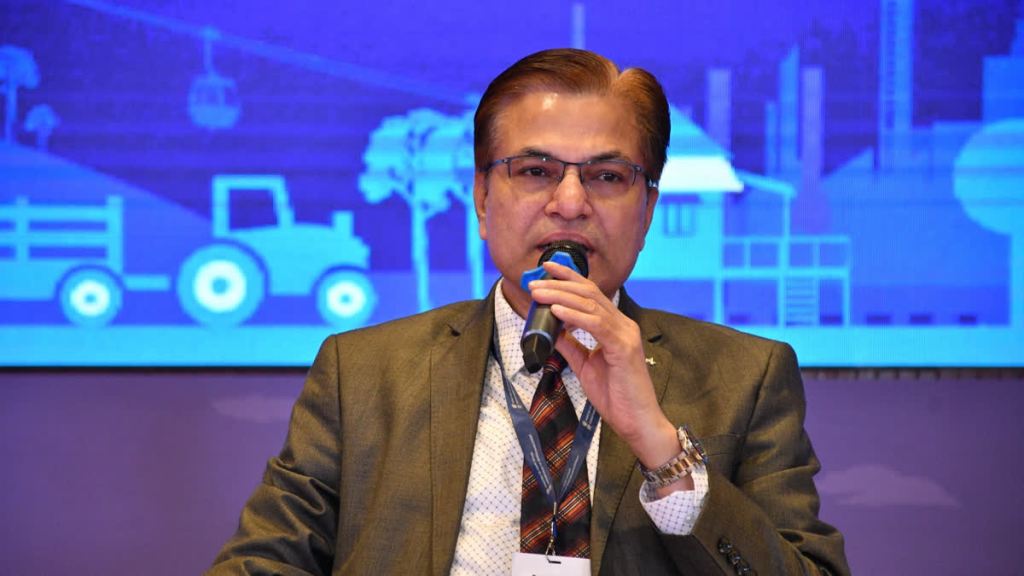
AI Surveillance Useful In Monitoring Challenging Terrain, Detecting Real-Time Threats: Rajendra Kumar

Secretary (border management) says to be effective in securing and managing borders, stakeholders need to synergise efforts through tech-intensive surveillance.
Source: https://www.etvbharat.com/en/bharat/ai-surveillance-useful-in-monitoring-challenging-terrain-detecting-real-time-threats-rajendra-kumar-enn26021903615

By ETV Bharat English Team

Published : February 19, 2026 at 3:46 PM IST

By Gautam Debroy

New Delhi: Stating that Artificial Intelligence (AI) can play an important role in transforming border management by enhancing and strengthening India’s ISR (Intelligence, Surveillance and Reconnaissance) ecosystem, Rajendra Kumar, Secretary (Border Management), said on Thursday that technologies like AI-powered surveillance sensors, drones, etc. can be very useful in monitoring challenging terrain and detecting threats in real time.

“AI can also play an important role in resource optimisation and optimal deployment of our border guarding forces for effective management of border areas. By enabling faster, data-driven decisions, AI can significantly improve efficiency in managing complex border security challenges,” he said, in an exclusive interview with ETV Bharat.

When asked whether AI has been used in border management, Kumar said, “As these technologies are constantly evolving, various stakeholders managing the borders would need to synergise their efforts through tech-intensive surveillance to be effective in securing and managing our borders. The use cases for deploying AI in border management are also constantly evolving.”

AI For Defence

Kumar said AI can act as a critical force multiplier in national defence, by accelerating decision-making, enhancing surveillance, and optimising logistics.

“AI-powered systems can analyse vast amounts of satellite, drone, and sensor data, to detect border intrusions and identify threats in real time. In cybersecurity, AI can identify and mitigate threats faster than humans, securing critical infrastructure. AI can drive unmanned autonomous vehicles (UAVs) and robotic systems for high-risk reconnaissance, protecting personnel,” he said.

According to Kumar, AI can also enable predictive maintenance of military equipment, ensuring operational readiness. “Ultimately, AI increases battlefield intelligence, agility, and efficiency,” he said.

Improve Governance, Services, Last-Mile Delivery

The border management secretary also said that AI can improve governance, delivery of citizen-centric services and last mile delivery, by automating administrative tasks, using predictive analytics for data-driven policymaking and fostering transparency.

“Citizen-centric services can be improved via multilingual AI chatbots, personalised services in various domains like health and education, and faster, automated grievance redressal. For this, the government needs to develop a full AI stack, comprising AI compute infrastructure and models, which will enable various ministries and departments to quickly develop and deploy their own applications for various use cases. Together, these innovations can enhance public service delivery, making it more efficient and inclusive,” he said.

AI Summit A Showcase Of Whole-Of-Nation Approach

“I think hosting the India AI Impact Summit 2026 is a major achievement for the country, which will enhance its global leadership in digital and emerging technologies. It helps in bringing the focus sharply on ‘AI for Development’ and in prioritising tangible, population-scale solutions using AI,” said Kumar.

He said the summit showcases our unique “whole-of-nation” approach towards the development and deployment of AI, utilising Digital Public Infrastructure (DPI) to democratise technology and ensure equity in access.

“This initiative also helps bridge the global AI divide, showcasing how AI can drive sustainable growth and empower underserved communities,” Kumar said.

India A Leading AI User & Creator

According to Kumar, India is rapidly emerging as a leading AI user and creator, focusing on a ‘bottom-up’ approach through population-scale applications and DPI. “Ranked among the top three nations in the world in AI competitiveness, India is leveraging its massive talent pool and a rapidly growing start-up ecosystem, with over 30,000 AI-focused start-ups to drive innovation at scale. Its light-touch regulatory approach, combined with its rich and diverse data, positions it as a critical and unique player in the global AI landscape,” said Kumar.

To further develop India’s AI ecosystem, Kumar said we need to focus on boosting our sovereign AI capabilities and build localised, multilingual AI-driven solutions in diverse domains, such as healthcare, education, agriculture, logistics, etc.

(The above interview was published on February 19, 2026 on ETV Bharat. It is available at: https://www.etvbharat.com/en/bharat/ai-surveillance-useful-in-monitoring-challenging-terrain-detecting-real-time-threats-rajendra-kumar-enn26021903615)
Digital India 2.0: Digital Transformation for Viksit Bharat @2047

Digital Transformation and Economic Growth

Source: Generated using Meta AI by the author

Viksit Bharat @2047 aims to transform India into a developed nation by 2047. Broadly, the vision of Viksit Bharat can be divided into five key thematic areas: thriving and sustainable economy; empowering citizens; innovation, science and technology; good governance and security; and enhancing India’s global standing. As India has achieved remarkable success in digitalising its economy under the Digital India programme, can this programme be reimagined to leverage digital transformation in these areas to achieve the vision of Viksit Bharat?

Digitalization can significantly contribute to a thriving economy. India’s over $400 billion digital economy in itself is a major contributor to the overall economy and its continued growth is essential for achieving the vision of Viksit Bharat. Digital public infrastructure (DPI) like Aadhaar and UPI have revolutionalised online identity authentication and payments and have empowered individuals and businesses. Similar DPI initiatives, public-private partnerships (PPPs) and leveraging Artificial Intelligence (AI) and other emerging technologies can digitally transform sectors like manufacturing, healthcare, education, agriculture, etc. and enhance economic growth. 

Improving access to digital services and infrastructure and digital empowerment through initiatives like BHASHINI can enhance digital inclusion, particularly for disadvantaged communities.  

Digital transformation is also essential for fostering innovation and technological advancement. It can also be used to promote green technologies and sustainable practices. Smart cities initiative is already showing how scalable digital transformation and PPPs can address challenges like sustainable urban planning and climate change. Digitalisation can also enhance good governance and improve India’s standing as a global leader in sustainable economic growth.

To achieve the vision of Viksit Bharat and create such an economy and society wide impact over the next two decades, the Digital India programme needs to be reimagined as a cross-sectoral mission based on a whole of government and whole of society framework.

This new mission, Digital India 2.0, needs to be architected on certain key foundations for accelerating digital transformation across various sectors. First, it needs to focus on creating world-class digital infrastructure including AI-ready data centres and high-speed connectivity through fibre and mobile reaching all villages. With AI emerging as a key platform technology that would drive transformation across various sectors in future, the need for making India a global hub for AI-ready data centres with high-performance hardware and robust network infrastructure cannot be overemphasized. Expansion of data centre infrastructure would also address the need to ensure data privacy, security and data storage within the country.

Second, digital government and digital services need to undergo a major transformation through a focus on delivering integrated, pro-active and personalised services using AI. This would require building a unified AI stack as a digital public infrastructure (DPI) comprising AI-ready data centres, access to curated data sets, and AI models and applications to enable the ministries and departments to develop their own use cases quickly. 

Third, the growth of the digital economy needs to be accelerated so that its share increases to at least 25% of the overall GDP of $30 trillion by 2047 from its present level of around 11%. This requires sustained growth in electronics and semiconductors, IT-ITES, and emerging technologies, such as AI, 6G, quantum computing, IoT, etc. However, a major contribution to the growth of the digital economy is likely to come from digitalisation of the traditional sectors, e.g., agriculture, health, education, financial services, retail, etc. Building a vibrant start-up ecosystem in these domains is essential for achieving this goal.

Fourth, we need to revamp our legal and regulatory framework to support the rapid growth of the digital economy. The major issues that need to be addressed include concerns on data privacy, cyber security, accountability of online platforms including social media, and fairness and transparency of AI algorithms. Though privacy concerns have been addressed through the new Digital Personal Data Protection (DPDP) Act, a full revamp of the 25 year old IT Act needs to be undertaken to address these issues comprehensively.

Fifth, rapid advancements in strategic and emerging technologies with ownership of intellectual property is a sine qua non for becoming a global leader in digital economy. We need to quickly formulate national strategies in these critical areas and fund the flagship initiatives. The IndiaAI Mission is a step in the right direction. However, we need to build our own foundational models in AI to ensure strategic autonomy in this rapidly advancing technology. Similarly, a national policy on data governance also needs to be formulated to ensure easier access to data by all the ministries, states, industry, start-ups, researchers, etc. This would allow rapid innovations to happen in these technologies.

Last, but not the least, skilling and capacity building in digital technologies at all levels is vital for rapid growth in the digital economy. India should rightly aim at becoming the skill and talent capital of the world.

Digital India 2.0, with its focus on a whole-of-government and whole-of-society approach, can accelerate digital transformation across various sectors to achieve the vision of Viksit Bharat.

(The views expressed are personal.)